Home Financing Starts With the Right Loan Structure
Home financing means choosing a mortgage that fits your income, down payment, credit profile, property type, and long-term plans. Start by comparing three things: the loan program, the repayment term, and whether the rate is fixed or adjustable. Then get a documented pre-approval before making offers, and compare each lender’s official Loan Estimate for total cost, not just the monthly payment.
For many buyers, the main paths are:
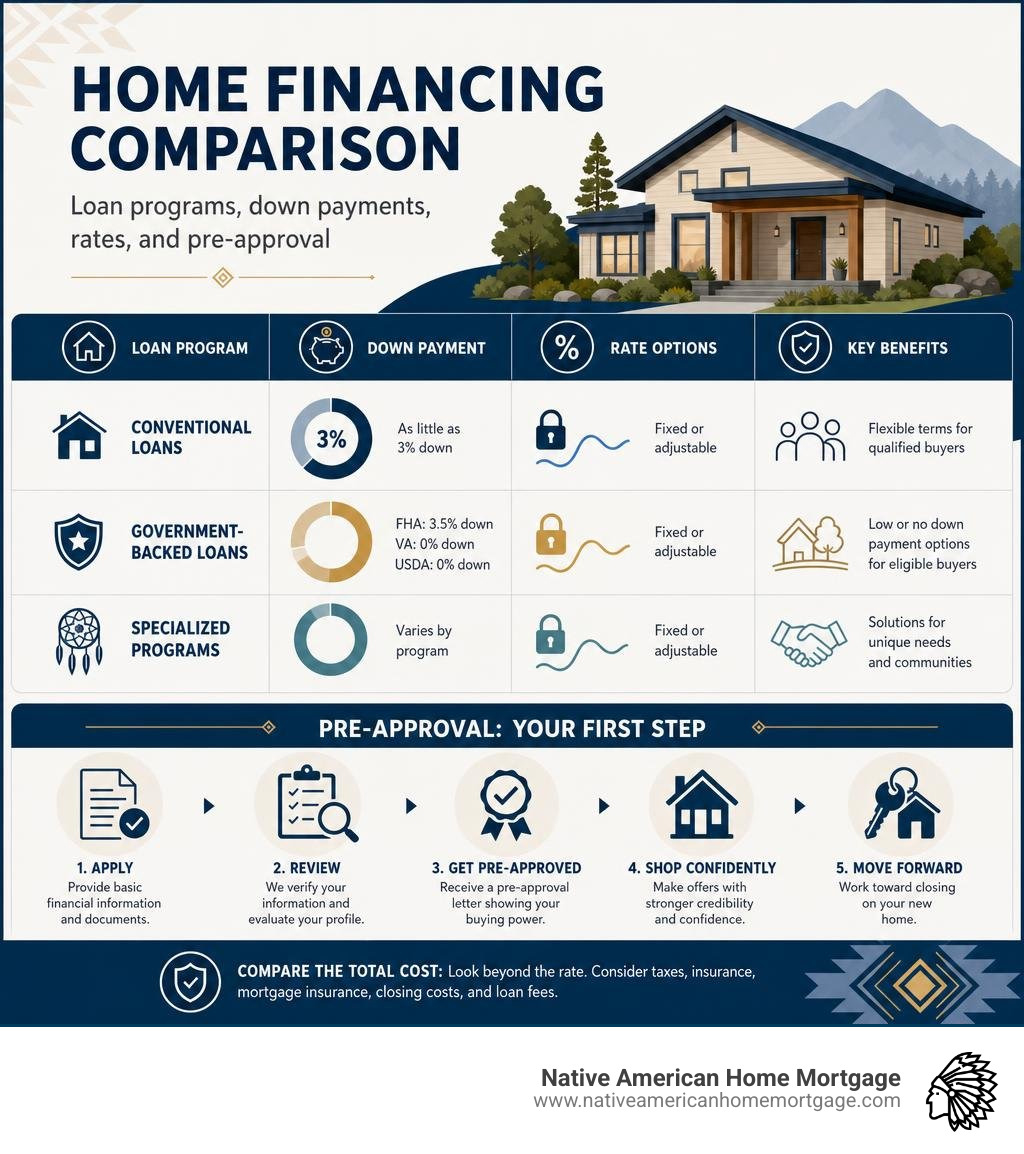
- Conventional loans: Often available with as little as 3% down for qualified borrowers.
- Government-backed loans: FHA can allow 3.5% down; eligible VA borrowers may qualify for 0% down; USDA loans can also offer no-down-payment financing in eligible rural areas.
- Specialized programs: These may include the HUD Section 184 Indian Home Loan Guarantee Program, tribal-community options, manufactured-home financing, and local down payment assistance.
The right option is not always the one with the lowest advertised rate. Taxes, homeowners insurance, mortgage insurance, closing costs, and loan fees can change the true cost. For Native American borrowers, it is also important to work with a lender who understands Section 184 financing, tribal trust land, and the property rules that can affect approval.
I am Dale Gremillion, a Senior Loan Officer and Producing Branch Manager with more than 25 years of residential lending experience, including Conventional, FHA, VA, USDA, and HUD Section 184 loans. My work in home financing focuses on building clear, practical loan strategies for first-time buyers, tribal-community borrowers, and experienced homeowners alike.
Core Types of Home Financing and Mortgage Programs
Navigating the mortgage market begins with understanding how loans are classified, funded, and insured. At its core, every mortgage is an agreement where the property serves as collateral for the debt. If you make your payments, you build equity and eventually own the home free and clear. If you do not, the lender can take possession through foreclosure.
Lenders generally divide home financing options into three primary categories: conventional mortgages, government-backed loans, and specialized loan initiatives designed for specific borrower groups.

Conventional and Conforming Mortgages
Conventional loans are originated and funded by private financial institutions—such as mortgage banks, credit unions, and commercial lenders—without direct government insurance.
Most conventional loans are “conforming,” meaning they adhere to underwriting guidelines and maximum dollar limits established by the Federal National Mortgage Association (Fannie Mae) and the Federal Home Loan Mortgage Corporation (Freddie Mac). When loan amounts exceed these baseline conforming limits, they are classified as non-conforming or “jumbo” loans, which require higher credit scores, larger cash reserves, and bigger down payments.
Key features of conventional financing include:
- Down payment flexibility: First-time buyers can qualify for conventional loans with as little as 3% down.
- Private Mortgage Insurance (PMI): When you put down less than 20%, lenders require PMI to protect against default. Unlike government-backed insurance programs, conventional PMI automatically terminates once your loan-to-value (LTV) ratio reaches 78% of the original purchase price (or when you request cancellation at 80% based on equity growth and payments).
- Credit guidelines: Conventional loans generally require higher minimum credit scores (typically 620 or higher) and lower debt-to-income (DTI) ratios than government programs to secure the best pricing.
Government-Backed Loan Programs
For buyers who need lower down payment thresholds, more flexible credit score criteria, or specialized underwriting, the federal government offers several loan guarantee programs. In these scenarios, private lenders originate the mortgage, but a government agency backs the loan against default.
- FHA Loans (Federal Housing Administration): Designed to expand access to homeownership, FHA loans permit down payments as low as 3.5% for borrowers with credit scores of 580 or higher. These loans require both an upfront mortgage insurance premium (UFMIP) and an annual mortgage insurance premium (MIP) paid monthly. For detailed comparisons between agency products, explore FHA and Section 184: Your Guide to the Indian Loan Guarantee Program.
- VA Loans (U.S. Department of Veterans Affairs): Available to eligible active-duty service members, veterans, and surviving spouses, VA loans offer up to 100% financing (0% down payment) without monthly private mortgage insurance. They require an upfront VA funding fee, which can be financed into the loan balance or waived for disabled veterans.
- USDA Loans (U.S. Department of Agriculture): Tailored to low- and moderate-income buyers in designated rural and suburban areas, USDA Rural Development loans offer 0% down payment financing with modest guarantee fees.
Specialized Home Financing for Tribal and Community Borrowers
Beyond standard federal and conventional products, targeted programs support Native American borrowers, union members, and buyers in specific housing segments.
The premier tribal housing initiative is the Section 184 Indian Home Loan Guarantee Program, managed by the U.S. Department of Housing and Urban Development (HUD). Designed specifically for enrolled members of federally recognized tribes, Alaska Natives, and Tribally Designated Housing Entities (TDHEs), the program addresses historical lending barriers on both fee-simple and tribal trust lands.
Borrowers interested in Native homeownership can review A Complete Guide to Native American Home Loans and Buyer Programs to understand how tribal sovereign land leasing, Bureau of Indian Affairs (BIA) Title Status Reports (TSR), and low-down-payment options work together.
Community-specific programs also include:
- Manufactured Housing Programs: Specialized financing allowing permanently affixed manufactured homes on owned or leased land to qualify for standard 30-year fixed-rate financing with down payments as low as 3%.
- Union Member Benefits: Programs such as Union Plus provide dues-paying labor union members, retirees, and their immediate families with $500 closing gifts for purchases, $300 for refinances, and $1,000 grants for union veterans, alongside hardship protections in the event of strikes or layoffs.
Key Elements: Loan Terms, Rates, and Structuring Your Mortgage
Every mortgage consists of three core components: the loan program, the repayment term (length of time to repay), and the interest rate structure. How you combine these variables dictates your monthly cash flow, the speed at which you build home equity, and the total interest paid over the life of your mortgage.

Fixed-Rate vs. Adjustable-Rate Mortgages
The choice between a fixed-rate mortgage and an adjustable-rate mortgage (ARM) centers on your risk tolerance and how long you plan to stay in the home.
- Fixed-Rate Mortgages: The interest rate remains locked for the entire life of the loan. Your principal and interest payment never changes, offering long-term budgeting certainty. Your total monthly payment can still fluctuate slightly if local property taxes or homeowners insurance premiums change within your escrow account.
- Adjustable-Rate Mortgages (ARMs): An ARM offers an initial fixed-rate period (commonly 5, 7, or 10 years) at a lower starting interest rate than comparable fixed loans. After this initial period expires, the interest rate resets periodically (usually every six months or annually) based on a benchmark market index plus an established lender margin.
ARMs feature rate caps that limit how much the interest rate can increase during the first adjustment, subsequent adjustment periods, and over the life of the loan.
| Feature | Fixed-Rate Mortgage | Adjustable-Rate Mortgage (ARM) |
|---|---|---|
| Payment Stability | 100% predictable principal & interest | Predictable during intro period; fluctuates after |
| Initial Interest Rate | Standard market rate | Often lower than fixed rates during intro term |
| Best Used When… | Planning to stay in the home long-term | Planning to move or refinance before first reset |
| Market Share (2008–2022) | 85% to 95% of homebuyers | 5% to 15% of homebuyers |
| Historical Market Share | 70% to 75% of homebuyers | 25% to 30% of homebuyers |
Between 2008 and 2022, 85% to 95% of homebuyers chose fixed-rate mortgages due to historically low interest rates. Historically, however, 25% to 30% of buyers selected ARMs. If you know with certainty that you will relocate or sell within five years, an ARM can provide meaningful interest savings during that initial window.
Comparing 15-Year and 30-Year Loan Terms
The loan term is the agreed-upon duration required to pay off the balance through scheduled monthly payments. While lenders offer terms ranging from 10 to 40 years, 15-year and 30-year terms represent the vast majority of originations.
Shorter loan terms typically offer interest rates that are lower by up to a full percentage point compared to 30-year loans. However, because you are compressing the repayment timeline by half, the required monthly payment is significantly higher.
| Loan Scenario ($300,000 Loan Amount) | 30-Year Fixed (6.75% Interest) | 15-Year Fixed (6.00% Interest) |
|---|---|---|
| Monthly Principal & Interest | $1,946 | $2,532 |
| Total Payments Over Life of Loan | $700,462 | $455,679 |
| Total Interest Paid | $400,462 | $155,679 |
| Lifetime Interest Savings | — | $244,783 |
A 15-year term builds equity rapidly and saves substantial interest. Conversely, a 30-year term provides lower mandatory monthly obligations, giving you more flexibility in your monthly budget. Borrowers with a 30-year loan can always make extra principal payments when cash flow permits, achieving similar interest savings without the legal obligation of a higher monthly minimum payment.
Assessing Affordability, Down Payments, and Total Ownership Costs
Determining how much home you can purchase involves evaluating your income stability, recurring monthly debts, down payment reserves, and recurring ownership expenses.
A common starting point for home affordability is allocating no more than 25% to 28% of your gross monthly income toward your housing payment (principal, interest, property taxes, and insurance). Lenders evaluate two specific debt-to-income (DTI) metrics during underwriting:
- Front-End DTI: The percentage of your gross monthly income dedicated exclusively to housing costs.
- Back-End DTI: The percentage of your gross monthly income required to cover housing costs plus all recurring consumer debts (credit card minimum payments, auto loans, student loans, child support). Most programs cap back-end DTI between 41% and 50%, depending on credit score and compensating factors.
Navigating Down Payments and Home Financing Assistance
Saving for a 20% down payment is not required to buy a home. Down payment requirements vary significantly across programs:
- Conventional: As low as 3% for qualified first-time buyers.
- FHA: As low as 3.5% with a 580+ credit score.
- HUD Section 184: 2.25% down payment for loans over $50,000 (and 1.25% for loans under $50,000). For complete criteria, consult The Complete Guide to Section 184 Loan Qualifications and Guidelines.
- VA and USDA: 0% down payment options for eligible borrowers.
Down payment assistance (DPA) programs, offered through state housing finance agencies, municipal programs, and non-profits, provide grants or forgivable second mortgages to cover upfront cash requirements.
When utilizing down payment grants, note that assistance funds valued at $600 or more may be treated as taxable income by the IRS and reported on Form 1099-MISC. Always consult a tax professional to evaluate how homeownership grants interact with your overall financial picture.
Factoring in Closing Costs, Taxes, and Insurance
Your monthly mortgage payment is rarely just principal and interest. Lenders typically establish an escrow account to collect one-twelfth of your annual property taxes and homeowners insurance premiums alongside each monthly mortgage payment.

A standard housing payment consists of PITI:
- Principal: The portion of your payment reducing the loan balance.
- Interest: The fee charged by the lender for borrowing the money.
- Taxes: Local real estate property taxes assessed by your county or municipality.
- Insurance: Homeowners hazard insurance, flood insurance (if required), and private mortgage insurance (PMI/MIP) where applicable.
Beyond recurring monthly expenses, you must also prepare for upfront closing costs, which generally range between 2% and 5% of the total loan amount. These include:
- Lender Fees: Application, underwriting, and loan origination fees.
- Discount Points: Optional prepaid interest purchased at closing to permanently lower your ongoing interest rate (one point equals 1% of the loan amount).
- Third-Party Services: Professional appraisal fees, credit report charges, flood certification, and survey costs.
- Title and Settlement Charges: Title search, lender’s title insurance policy, closing/settlement attorney fees, and recording fees with the local municipality.
The Mortgage Approval Process and Loan Safeguards
Securing home financing is a structured sequence that moves from initial financial review to final loan funding. Understanding the approval milestones helps protect your earnest money and ensures a seamless closing.
Pre-Qualification vs. Verified Pre-Approval
Many homebuyers confuse pre-qualification with pre-approval, but sellers and real estate agents treat them very differently:
- Pre-Qualification: An informal estimate of what you might be able to borrow based on self-reported income, debt, and assets, often utilizing a soft credit inquiry that does not affect your credit score. It provides a helpful ballpark budget but carries little weight in competitive offer situations.
- Verified Pre-Approval: A comprehensive review where an underwriter examines your financial documentation—including W-2s, 1099s, federal tax returns, recent pay stubs, and bank statements—alongside a hard credit check. A formal pre-approval letter provides sellers with tangible proof of your buying power.
Pre-approval letters typically remain valid for 90 days. Because financial documentation expires, you must avoid taking on new consumer debts, changing jobs, or shifting large sums of unverified money between accounts during this period. For actionable techniques to strengthen your file before applying, read our guide on Native American Mortgage Approval Odds and How to Improve Them.
Risky Loan Features to Avoid
Modern lending regulations established under the Dodd-Frank Act require lenders to issue “Qualified Mortgages” (QM) that document and verify a borrower’s reasonable ability to repay (ATR). Non-qualified mortgages exist for specialized circumstances (such as bank statement loans for self-employed individuals), but buyers should exercise caution and avoid predatory loan structures:
- Prepayment Penalties: Fees assessed if you pay off the mortgage early, sell the property, or refinance within a designated timeframe. Standard QM loans do not contain prepayment penalties.
- Balloon Payments: Structures featuring low introductory payments followed by a massive lump-sum balance due at an arbitrary date (e.g., 5 or 7 years). If you cannot refinance or pay the balance, you risk losing the property.
- Negative Amortization: Loans where scheduled payments do not cover the accrued monthly interest, causing the unpaid interest to be added to the principal balance—meaning you owe more over time rather than less.
- Interest-Only Periods: Mortgages where you pay only the interest charges for an initial term, building zero equity unless property values appreciate.
Always review the official three-page Loan Estimate provided by your lender within three business days of application. If you spot unfamiliar terms or fees, ask your loan officer to reissue an estimate reflecting a safer, standard amortized loan product.
Frequently Asked Questions About Home Loans
How much home can I realistically afford on my current income?
As a baseline rule of thumb, your total monthly housing cost should not exceed 25% to 28% of your gross monthly income. To determine your maximum borrowing limit, lenders evaluate your total debt-to-income (DTI) ratio.
For example, if your household earns $8,000 per month gross, a 28% front-end allocation gives you a target monthly housing budget of approximately $2,240 (including principal, interest, taxes, and insurance). If you have $500 in monthly auto and student loan payments, your total recurring debt would be $2,740, representing a healthy back-end DTI of roughly 34%.
What is the minimum down payment required for first-time buyers?
Minimum down payment requirements depend entirely on the loan program:
- 0% Down: VA loans (for eligible veterans/service members) and USDA loans (for eligible rural properties).
- 2.25% Down: HUD Section 184 loans for tribal members on loans exceeding $50,000.
- 3% Down: Conventional conforming loans designed for first-time buyers.
- 3.5% Down: Standard FHA loans for borrowers with credit scores of 580 or higher.
How long does a mortgage pre-approval remain valid?
A formal mortgage pre-approval is typically valid for 90 days. Lenders establish this timeframe because credit reports, pay stubs, and asset statements become outdated under secondary market underwriting standards. If your home search extends beyond 90 days, your loan officer can easily refresh your pre-approval by pulling updated pay stubs, bank statements, and a refreshed credit profile.
Conclusion
Financing a home is one of the most consequential financial steps you will ever take, but it does not have to be overwhelming. When you understand the core differences between conventional loans, government-backed programs, and specialized tribal initiatives, you can select a loan structure tailored to your exact budget and homeownership goals.
Take the time to gather your financial records, compare official Loan Estimates across lenders, and avoid risky mortgage features that compromise your long-term equity.
When you are ready to explore specialized home financing and mortgage options, our team is here to guide you through every step of the approval process. Visit our homepage to explore specialized home financing and mortgage options and take the first step toward securing your new home today.