Construction to Permanent Loans: Build With One Loan and One Closing
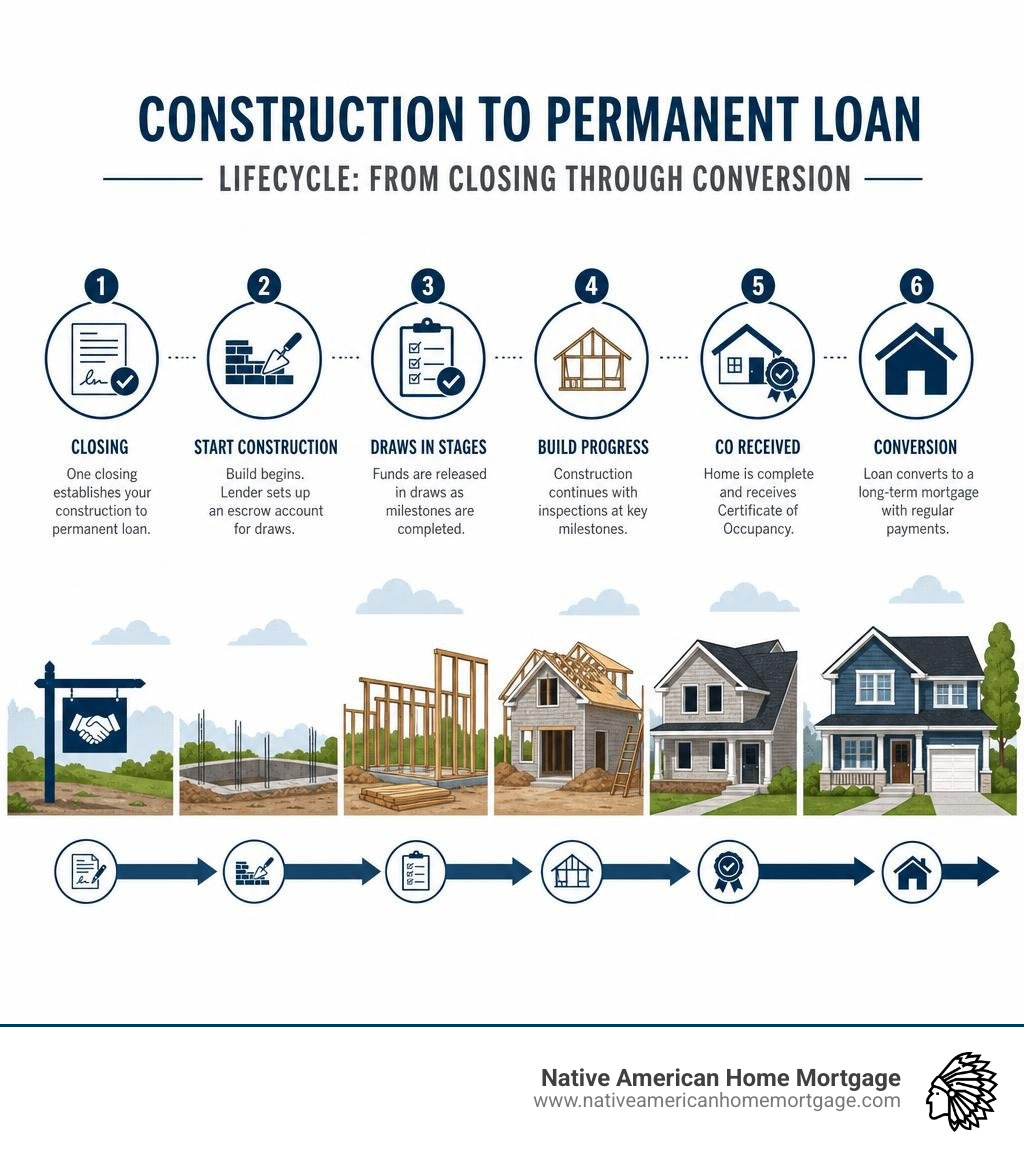
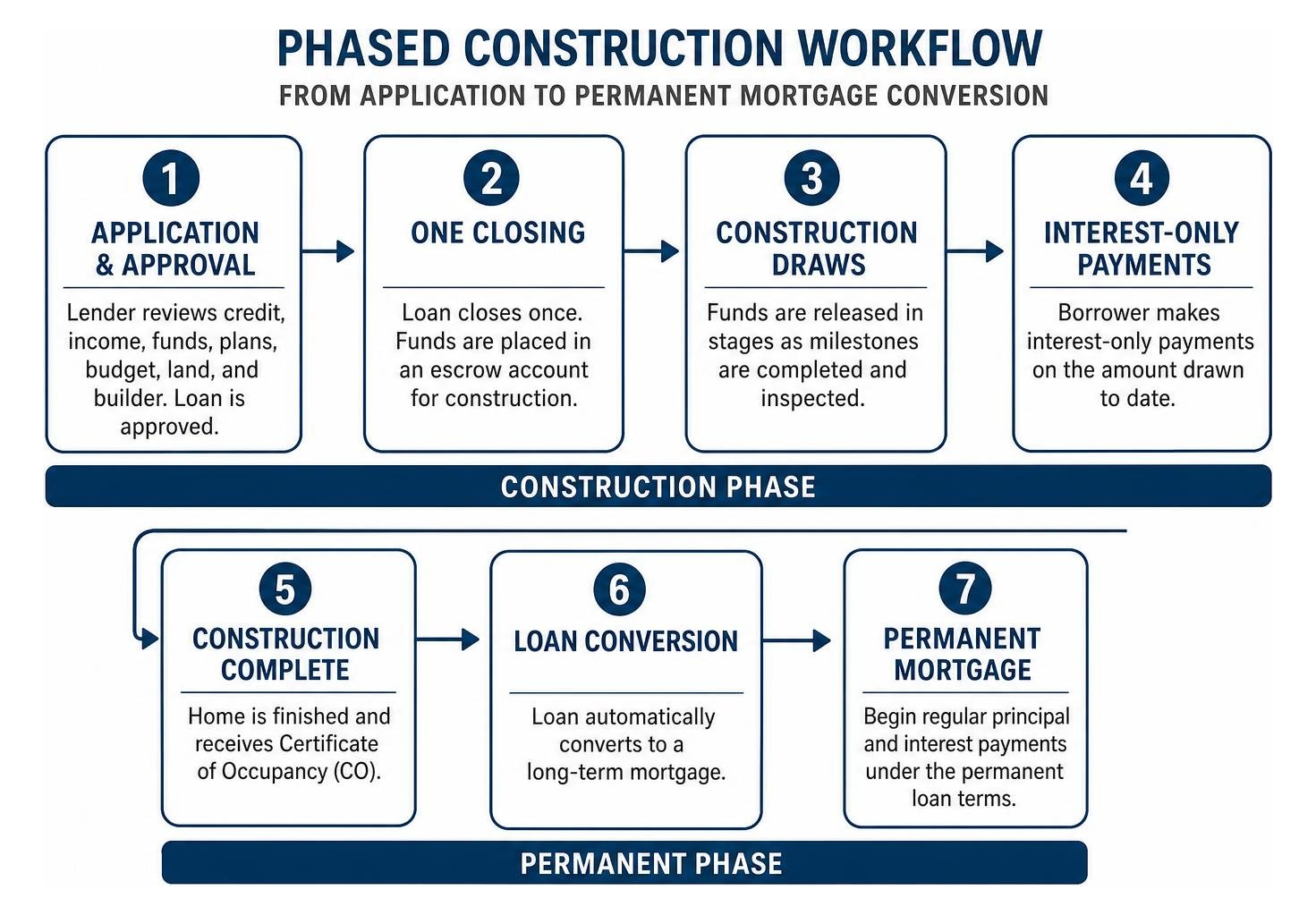
Construction to permanent loans combine the money to buy land (when eligible), build a home, and finance the completed home into one loan. You close once, receive construction funds in stages as work is completed, and usually make interest-only payments on the amount already drawn. When the home is finished and receives its certificate of occupancy, the loan converts to a long-term mortgage.
This structure can make a custom build easier to plan because it may avoid a second mortgage application and a second set of closing costs. It can also provide rate protection before construction begins. But approval is more detailed than for a standard home loan: lenders commonly review your credit, income, available funds, building plans, budget, land, and builder.
For Native American borrowers, the right program also matters. Conventional, FHA, VA, and HUD Section 184 options can have different rules for down payments, property location, land status, and eligible homes. A lender who understands these details can help you identify the financing path that fits both your project and community needs.
I am Dale Gremillion, a Senior Loan Officer and Producing Branch Manager with more than 25 years of residential lending experience, including Conventional, FHA, VA, USDA, HUD Section 184, and construction to permanent loans. In this guide, I will walk through the requirements, draw process, timelines, and choices to consider before you commit to a build.
How Construction to Permanent Loans Work
Building a custom home from the ground up differs from purchasing an existing property. In a standard purchase, the lender releases the full loan amount on closing day to the seller. With a construction-to-permanent loan, the lender sets up an interim escrow account. Instead of paying out everything upfront, funds are disbursed in increments called draws as specific milestones of the build are achieved.
During this building phase, borrowers make interest-only payments based strictly on the funds disbursed to date. For instance, if your total loan amount is $500,000, but only $75,000 has been paid to the builder for foundation work, your monthly payment reflects interest on $75,000, not the entire $500,000 balance. This keeps carrying costs manageable while you may still be paying rent or an existing mortgage elsewhere.
To review every stage of this process from initial architectural drafts to final move-in, check out The Ultimate Guide to Construction to Permanent Loans. Lenders also mandate contingency reserves—typically between 5% and 10% of construction costs—to cover unexpected supply price changes or minor plan revisions. Once construction concludes, local authorities issue a Certificate of Occupancy (CO), and the loan automatically converts into a standard, fully amortizing long-term mortgage.
Single-Closing vs. Two-Closing Construction to Permanent Loans
Choosing between a single-closing and a two-closing transaction is one of the most critical financing decisions you will make.
In a single-closing (one-time close) transaction, both the interim construction financing and the permanent mortgage are secured at the same time. You sign loan documents once, pay a single set of closing fees, and lock in your permanent interest rate prior to groundbreaking. This structure eliminates interest rate volatility during construction and protects you from having to requalify when the house is completed. Standard guidelines under Fannie Mae, detailed in their Conversion of Construction-to-Permanent Financing: Single-Closing Transactions | Fannie Mae documentation, provide clear rules for converting these notes seamlessly.
A two-closing transaction, by contrast, treats the build and the final mortgage as two separate transactions. You take out a short-term construction loan first, pay one set of closing costs, build the home, and then apply for a brand-new permanent mortgage to pay off the interim loan. While this allows you to shop for permanent interest rates closer to project completion, it requires two underwriting processes, duplicate loan fees, and the risk that shifting market conditions or changes in your financial status could complicate final mortgage approval.
The Construction Draw Process and Project Timelines
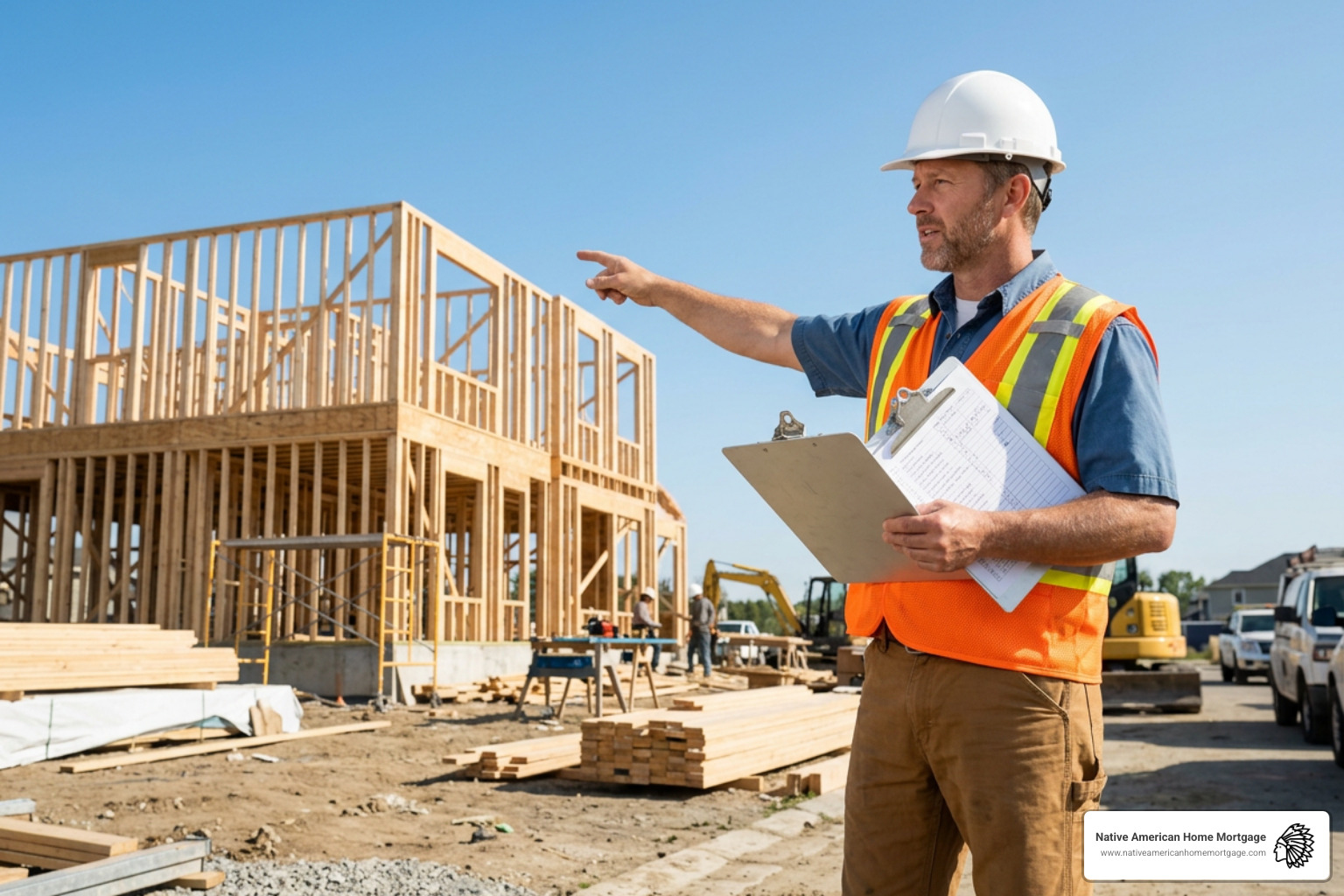
The draw process ensures that funds are distributed responsibly as real work occurs. Before any money is released, the lender verifies the credentials of your licensed general contractor and agrees on a formal draw schedule aligned with building phases:
- Foundation & Site Prep: Clearing, excavation, footings, and slab or basement pouring.
- Framing & Sheathing: Wall framing, roof trusses, subflooring, and exterior sheathing.
- Mechanicals (“Rough-Ins”): Plumbing, electrical wiring, and HVAC ductwork installed behind the walls.
- Drywall & Interior Finishes: Insulation, drywall hanging, cabinetry, interior trim, and painting.
- Final Finishes & Exterior: Flooring, plumbing fixtures, lighting, landscaping, and final grading.
Prior to releasing payment for any stage, an independent inspector visits the job site to confirm that the work meets building codes and matches the draw request. Lenders often implement a retainage holdback—withholding roughly 10% of each draw—until the final punch list is complete and all mechanics’ lien waivers are executed.
Project timelines are subject to firm rules. Most single-close programs enforce a 12-month limit per construction segment, with an absolute 18-month cap for the overall construction phase. Unforeseen construction delays caused by severe weather or supply chain disruptions must be managed closely with your lender to avoid falling out of program compliance.
Core Eligibility and Underwriting Criteria
Underwriting a construction-to-permanent mortgage involves evaluating two distinct elements: the borrower’s financial profile and the viability of the build itself.

Lenders perform an extensive builder review before approving the loan. Your builder must provide proof of general liability insurance, workers’ compensation coverage, appropriate state licenses, and references demonstrating a strong track record of on-time, on-budget project delivery. Owner-builder arrangements (acting as your own general contractor) are generally restricted unless you are a full-time, licensed home builder by trade.
You must also submit full architectural plans, complete specifications, and a detailed line-item cost breakdown. The appraiser uses these documents to establish an “as-completed” appraised value, ensuring the finished home will justify the total loan amount.
Qualifying for Construction to Permanent Loans: Credit, Income, and Land Equity
Borrower eligibility standards are slightly more demanding than standard purchase loans due to the added risk of interim construction.
- Credit Scores: Conventional single-close programs generally require a minimum credit score of 620 FICO (or 640 VantageScore). Government-backed alternatives provide additional flexibility, with FHA requiring 620 and VA options accommodating scores starting at 580.
- Debt-to-Income (DTI) Ratios: Borrowers must demonstrate stable, verifiable income. DTI thresholds typically max out between 45% and 50%, depending on automated underwriting system findings and compensating factors.
- Land Equity & Down Payment: If you already own your build site, the equity in your land can count directly toward the down payment requirement. If you purchased the lot within the past six months, lenders typically calculate value based on the lower of the purchase price or the current appraised land value. If owned for longer, the full appraised value of the land is used.
- Document Age: Because builds take months, Fannie Mae guidelines outlined in FAQs: Construction-to-Permanent Financing | Fannie Mae allow credit documents to remain valid for up to 18 months at conversion, provided the loan received an Approve/Eligible recommendation and loan-to-value (LTV) is 95% or lower.
Property Types and Allowable Builds
Construction-to-permanent loans can finance a wide variety of residential housing styles, provided they meet local zoning and agency guidelines as detailed in Construction Products | Fannie Mae :
- Stick-Built Custom Homes: Traditional on-site wood or steel framing for 1-unit primary residences.
- Modular Homes: Factory-built modules constructed to state building codes, transported to the site, and permanently anchored to a foundation.
- Manufactured Housing: Factory-built units built to federal HUD code, eligible under select conventional, FHA, and Section 184 programs when placed on an approved, permanent foundation.
- Detached Condominiums: Standalone residential units inside planned developments (attached condominiums and co-ops are generally excluded from single-close programs).
- Teardown Rebuilds: Demolishing an existing home on a lot you own to construct a brand-new primary dwelling.
- Accessory Dwelling Units (ADUs): Adding a secondary self-contained living unit alongside the main construction project to accommodate multi-generational living or produce future rental income.
Comparing Loan Programs and Financing Structures
Different loan programs cater to various borrower profiles, financial structures, and land ownership statuses. Whether working through conforming secondary market channels detailed by Construction to Permanent Mortgages – Freddie Mac Single-Family or specialized government guarantees, matching your project to the right financing structure is essential.
| Loan Program | Minimum Down Payment | Minimum Credit Score | Max LTV Ratio | Key Distinctive Feature |
|---|---|---|---|---|
| Conventional (Fannie/Freddie) | 5% | 620 FICO / 640 Vantage | 95% | Private mortgage insurance required over 80% LTV; up to 18-month document age flexibility |
| FHA One-Time Close | 3.5% | 620 | 96.5% | DTI allowed up to 50%; competitive government pricing |
| VA Construction Loan | 0% | 580 FICO / 600 Vantage | 100% | No monthly mortgage insurance; available up to full entitlement |
| HUD Section 184 | 2.25% (loans >$50k) | Flexible / Lender Overlay | 97.75% | Specialized for Native American and Alaskan Native borrowers on fee-simple or tribal trust land |
Conventional and Secondary Market Guidelines
Conforming single-closing construction loans purchased by Fannie Mae or Freddie Mac allow up to a 95% maximum LTV on 1-unit primary residences. For transactions with LTVs higher than 80%, private mortgage insurance (PMI) is required.
Underwriting is completed upfront through automated underwriting systems like Desktop Underwriter (DU). One of the greatest benefits of the conventional single-closing structure is price certainty: you lock your permanent 15- or 30-year fixed terms before breaking ground. When construction finishes, the lender issues a standard Loan Modification Agreement to adjust the final principal balance and set the definitive amortization schedule, without re-underwriting the loan or charging new origination fees.
Government-Backed Programs: FHA, VA, and Section 184
Government-insured options provide affordable avenues for borrowers who need lower down payments or more accommodating credit requirements:
- FHA One-Time Close: Permits a low 3.5% down payment and allows debt-to-income ratios up to 50%. It is well-suited for borrowers building custom or manufactured homes who want predictable long-term fixed rates.
- VA Construction Loan: Eligible veterans and active-duty military personnel can finance 100% of the build cost with zero down payment and no ongoing monthly mortgage insurance, backed by flexible credit criteria.
- HUD Section 184 Indian Home Loan Guarantee Program: Designed specifically for American Indian and Alaska Native families, Alaska Villages, and Tribally Designated Housing Entities. As detailed by the Section 184 Indian Home Loan Guarantee Program – HUD , this program features down payments as low as 2.25% on loans over $50,000, low annual guarantee fees, and the unique ability to finance new construction on fee-simple land, allotted trust land, and tribal trust land.
Frequently Asked Questions About Construction Financing
What happens if the home build exceeds the construction timeline?
Single-close guidelines usually restrict construction to an 18-month cap, structured with no individual segment exceeding 12 months. If severe weather, contractor delays, or permit complications push your project beyond 18 months, the loan can no longer convert under standard single-close rules. In this scenario, the interim loan must typically be restructured into a two-closing transaction, which may require updated credit documents, an appraisal reassessment, and a formal closing on the permanent mortgage.
Can I use equity in my land instead of a cash down payment?
Yes. If you already hold title to the lot where the home is being built, the equity in that property can directly fulfill your down payment requirement.
- For lots owned longer than six months, lenders base land equity on the full “as-completed” appraised market value of the lot.
- If you purchased the lot within the last six months, the value is usually determined by the lesser of your purchase price or the current appraised value.
If your equity exceeds the required down payment, it can cover closing costs and eliminate the need for out-of-pocket cash on closing day.
Do borrowers need to requalify when construction finishes?
Under a true single-closing construction-to-permanent loan, you generally do not need to requalify once the build is complete. Your credit, income, and assets are fully approved prior to the initial closing. However, if construction extends beyond standard document expiration limits (typically 120 to 180 days, or 18 months under specific low-LTV Fannie Mae provisions), or if the final loan amount changes substantially due to cost overruns, the lender may request updated pay stubs and a refreshed credit report before executing the permanent loan modification agreement.
Conclusion
Building your custom home gives you complete control over your living space, but securing the right financing is what turns blueprints into a reality. A construction-to-permanent loan streamlines this journey by bundling land acquisition, building expenses, and long-term financing into a single closing—saving you time, cutting duplicate fees, and protecting you from interest rate volatility.
Whether you are planning a stick-built home, a modern modular layout, or building on tribal trust land, understanding program parameters is key to a smooth build. We specialize in matching families with the right financing solutions across conforming, FHA, VA, and HUD Section 184 lending programs.
Ready to begin your build? Contact us at Native American Home Mortgage to discuss your plans, explore your construction purchasing power, and start your path toward homeownership today.