Understanding the Construction Loan Approval Process and Loan Types
Construction loan approval hinges on four core requirements: qualifying financials (typically a 680+ credit score, 20%–25% down payment, and a debt-to-income ratio under 45%), a vetted licensed general contractor with a detailed line-item budget, complete architectural plans and a subject-to-completion appraisal, and a clear loan structure—either a single-close construction-to-permanent loan or a two-time close stand-alone construction loan. Once approved, funds are released through milestone-based draws rather than a lump sum.
Financing ground-up construction is completely different from securing a standard 30-year fixed mortgage on an existing house. When buying an existing property, the lender secures the loan against a physical asset you can walk through today. With new builds, lenders finance an idea backed by architectural plans, materials, and labor contracts.
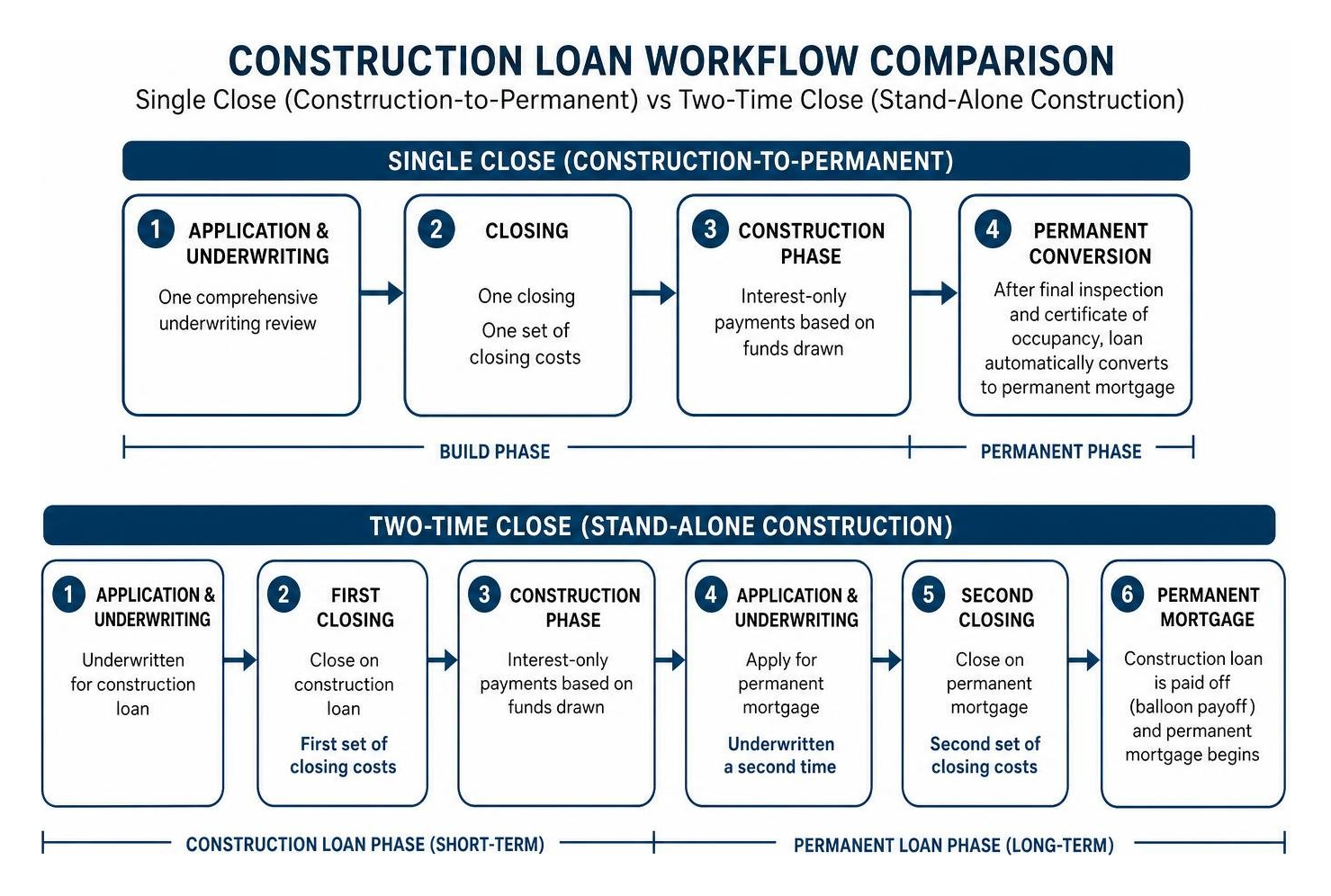
Because the house does not exist yet, construction financing acts as short-term, interim funding. During the building phase, you generally make interest-only payments based strictly on the funds drawn down to date, not the entire approved loan balance. Once the home passes final inspection and receives a certificate of occupancy, the temporary debt must be resolved. How that transition happens depends entirely on your loan structure.
The two main structures available to prospective home builders are:
- Construction-to-Permanent Loans (Single-Close): This structure wraps the construction financing and long-term mortgage into one single transaction. You sign loan documents once, pay one set of closing costs, and lock in your permanent interest rate upfront. When the home is finished, the loan automatically converts into a permanent mortgage without requiring a second underwriting process.
- Stand-Alone Construction Loans (Two-Time Close): This method breaks the project into two distinct loans. First, you obtain a short-term construction loan (lasting 6 to 24 months) to fund the build. Once construction wraps up, you apply for a separate permanent mortgage to pay off the interim construction balance. This approach requires two closings, two rounds of settlement fees, and exposes you to interest rate changes while the house is being built.
| Loan Feature | Construction-to-Permanent (One-Time Close) | Stand-Alone Construction (Two-Time Close) |
|---|---|---|
| Number of Closings | 1 closing | 2 separate closings |
| Closing Costs | Single set of fees (saves $3,000–$5,000) | Two full sets of closing fees |
| Interest Rate Risk | Permanent rate locked prior to ground-break | Exposed to market rate shifts during build |
| Underwriting Steps | One comprehensive underwriting review | Underwritten twice (initial build & takeout) |
| Payment Structure | Interest-only during build, then P&I | Interest-only during build, balloon payoff |
| Refinance Flexibility | Locked into primary lender terms | Freedom to shop permanent lenders at end |
Evaluating the Best Financing Paths for Construction Loan Approval
Choosing between these structures comes down to your tolerance for risk and cash-flow preferences. For the vast majority of custom home builds, a construction-to-permanent loan provides stability. Locking in your long-term interest rate before digging your foundation protects you from unexpected market spikes while saving thousands on duplicate title policies, escrow fees, and appraisal charges. Exploring single close construction to permanent loan options allows you to streamline the entire timeline.
However, if you anticipate receiving a significant liquidity event during construction—or if market mortgage rates are on a sharp downward trajectory—a stand-alone loan offers the option to shop for a permanent mortgage later. Reviewing comprehensive home financing options early in the planning phase ensures your financing structure aligns with your long-term financial goals.
Financial Requirements: Credit Scores, Down Payments, and Debt Ratios in 2026
Underwriting standards for construction loans are naturally stricter than those for existing homes because the lender takes on the risk of structural completion. Understanding these criteria ahead of time helps ensure you meet underwriting benchmarks before formally applying.
Here is a breakdown of the core financial benchmarks lenders use to evaluate construction applications:
- Credit Score Thresholds: Conventional construction programs typically require a minimum credit score of 680, though a benchmark of 700 to 740 or higher secures the most favorable rates. If your score falls between 680 and 699, lenders often look for compensating factors such as additional liquid reserves.
- Down Payment Requirements: Conventional programs usually expect a 20% to 25% down payment based on total project costs (land purchase price plus hard and soft build costs). While standard loans expect significant cash equity, government-backed programs such as FHA construction products allow lower down payments for qualifying borrowers. Checking 2026 construction loan benchmarks and criteria will clarify the exact tier your project fits into.
- Using Land Equity: If you already own the build site, the equity in your land can count directly toward your required down payment. If you purchased the lot outright or have paid down a land loan, a new subject-to-completion appraisal will factor in the lot’s current market value, often covering the equity requirement without requiring additional out-of-pocket cash.
- Debt-to-Income (DTI) Ratios: Most underwriters cap debt-to-income ratios between 43% and 45%. This calculation includes all of your existing monthly recurring debt payments plus the projected future housing payment (principal, interest, property taxes, and homeowners insurance).
- Liquid Cash Reserves: Beyond the down payment, lenders look for liquid asset reserves to cover unexpected issues. Expect to verify 6 to 12 months worth of interest-only payments in personal savings, brokerage, or retirement accounts.
- Current Interest Rates: In 2026, construction-phase interest rates typically hover between 7% and 9% (variable or fixed interest-only rates), while permanent take-out mortgage rates range from 6.5% to 7.5%, depending on credit tier and loan structure.
Builder Vetting and Blue Book Documentation
A solid financial profile is only half the battle. Lenders also review the general contractor who will manage your build. Because a builder default or shoddy workmanship puts the bank’s collateral at risk, underwriters thoroughly review the builder before clearing the loan to close.
Your contractor must provide comprehensive documentation for review:
- Licensing and Background: Proof of active, unencumbered state contractor licenses, business history, and a track record of similar completed residential projects.
- Insurance Coverage: Verified certificates of general liability insurance and active workers’ compensation policies.
- Line-Item Construction Budget (“The Blue Book”): A granular breakdown detailing all soft costs (permitting, architectural drawings, engineering) and hard costs (excavation, concrete, framing, plumbing, drywall, finishes). Every line item must reflect realistic local market rates.
- Comprehensive Construction Contract: A signed agreement between you and the builder outlining total contract price, payment draw triggers, change-order protocols, and an agreed-upon completion schedule (typically 6 to 12 months).
Checking established guidelines for builder verification and loan approval requirements ensures your builder submits compliant documentation right out of the gate.
Project Appraisals, Underwriting Milestones, and the Approval Timeline
One of the most common questions borrowers ask is: How does an appraiser value a home that has not been built yet?
The answer lies in a specialized appraisal called a subject-to-completion appraisal. Rather than inspecting an existing structure, a licensed appraiser analyzes your architectural blueprints, the detailed specifications from the builder’s blue book, and the land parcel itself. The appraiser compares your proposed home design against recent local sales of newly constructed homes with similar square footage, quality of finishes, and lot sizes to determine the future market value of the finished home.
Lenders use this appraised future value to set the loan-to-value (LTV) limit, which typically caps out at 80% to 85% of the projected completed value for conventional loans.
The underwriting timeline generally follows these milestones:
- Initial Submission: You submit your Uniform Residential Loan Application (Form 1003) alongside income verification (W-2s, tax returns, bank statements), the fully executed builder contract, and complete blueprints.
- Parallel Underwriting Track: The underwriter reviews your financial file while a specialized construction risk department reviews the builder’s credentials, budget feasibility, and draw schedule.
- Appraisal & Conditional Approval: The appraiser completes the subject-to-completion valuation. Once the appraisal supports the loan amount and builder qualifications pass, the lender issues a conditional approval.
- Closing: From application submission to loan closing, the timeline averages 30 to 60 days. Standard closing costs range from 2% to 5% of the total loan amount, covering origination, title work, underwriting, and upfront inspection fees.
Our comprehensive construction permanent loan guide covers the specific documentation you need to keep your file moving without delays.
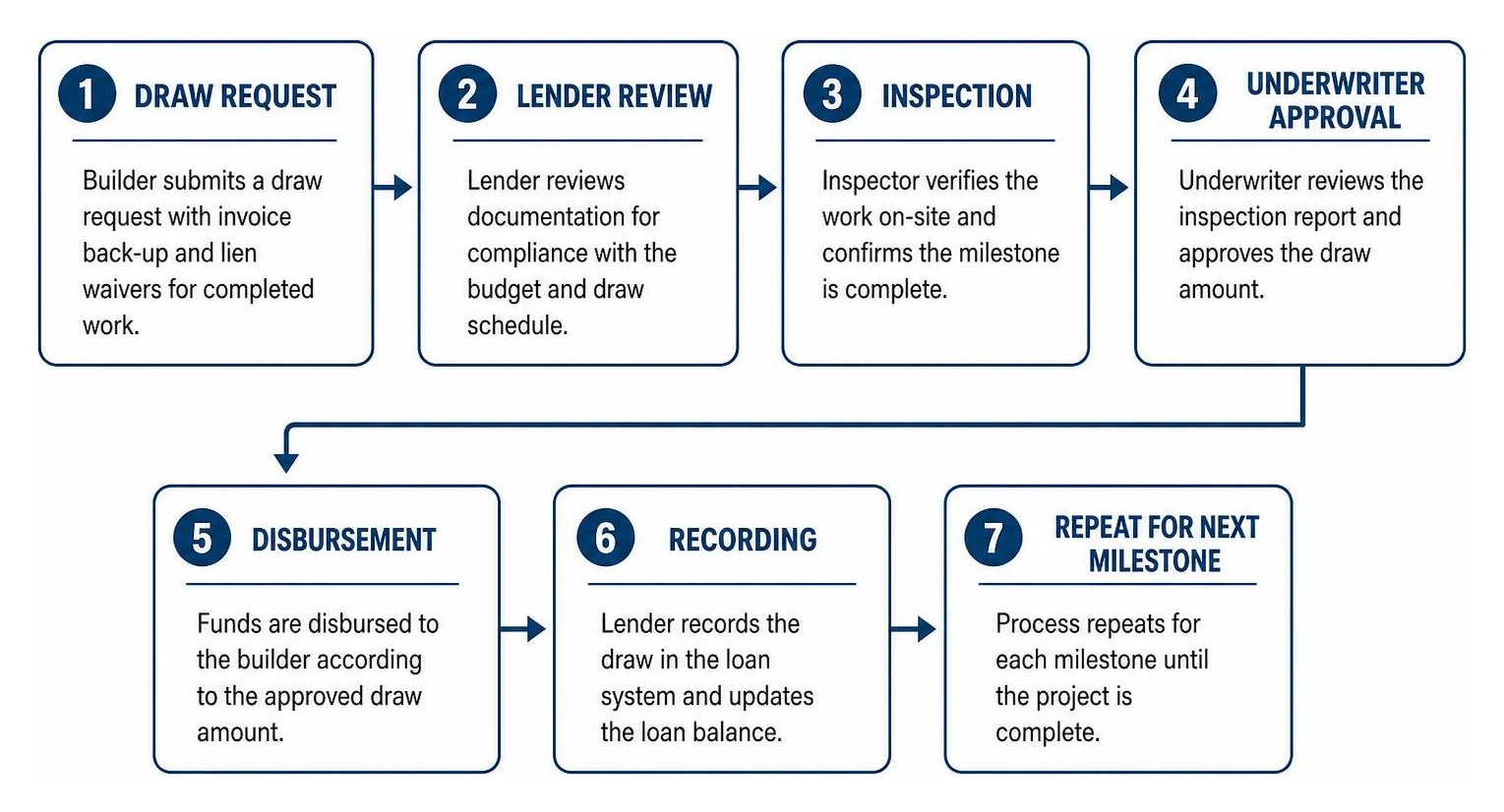
How to Master the Draw Schedule for Construction Loan Approval
Once your loan closes, construction funds are not handed over as a single lump sum. Instead, money is released incrementally through a draw schedule tied to tangible construction milestones.
A standard residential draw schedule consists of five to seven distinct disbursement phases:
- Site Preparation and Foundation: Excavation, footings poured, basement or slab completed, and waterproofing inspected.
- Rough Framing and Sheathing: Subflooring, exterior and interior load-bearing walls, roof trusses, and exterior sheathing installed.
- Mechanical Rough-Ins (Dried-In Phase): Roof shingles, exterior weather barrier, windows, doors, and initial plumbing, HVAC, and electrical wiring run throughout the framing.
- Insulation and Drywall: Thermal insulation installed and passed by municipal inspectors, drywall hung, taped, mudded, and sanded.
- Interior Finishes and Carpentry: Cabinetry, interior doors, trim, tile work, hard flooring, and initial coat of paint applied.
- Mechanical Trim and Fixtures: Sinks, faucets, lighting fixtures, switches, HVAC compressor, and electrical panels fully connected and operational.
- Final Completion and Retainage Release: Final touch-ups, site grading, municipal certificate of occupancy issued, and final punch-list items signed off.

When your builder reaches a milestone, they submit a formal draw request. The lender dispatches an independent inspector to the job site to confirm that the work matches the request. Once verified, funds are released—typically within a 3 to 5 business day cycle.
Risk Management: Lien Waivers, Builder Insurance, and Avoiding Critical Mistakes
Custom builds are dynamic projects with multiple moving parts. Protecting your financial investment requires managing project risks, securing the right insurance, and maintaining clear communication with your trade partners.

Mechanics Liens and the Vital Role of Lien Waivers
A mechanics lien is a legal claim placed against your property by a subcontractor, supplier, or laborer who was not paid by your general contractor. Even if you have paid your general contractor on time, an unpaid framing crew or lumber yard can file a lien against your title, stalling the project and threatening loan conversion.
To protect yourself, require lien waivers with every single draw:
- Conditional Lien Waivers: Signed by subcontractors alongside the draw request, stating they agree to waive lien rights conditional upon receiving payment for that specific milestone.
- Unconditional Lien Waivers: Signed after payment clears, providing legal confirmation that the subcontractor has been paid in full for work performed through that date.
Required Construction Phase Insurance
Standard homeowners insurance policies do not cover structures under active construction. Lenders mandate specific insurance coverage prior to closing:
- Builder’s Risk Insurance: Protects the uncompleted structure and on-site building materials from hazards like fire, windstorms, vandalism, lightning, and theft. The policy must list the lender as an additional insured/loss payee.
- Contractor General Liability: Covers on-site accidents, property damage, and bodily injury resulting from construction operations.
Common Pitfalls to Avoid
Cost overruns and timeline delays are the two biggest challenges in custom home building. To keep your project running smoothly:
- Build a 10% to 15% Contingency Reserve: Set aside dedicated funds within your approved construction budget to absorb unexpected price increases in lumber, plumbing changes, or soil excavation issues without pausing work.
- Minimize Mid-Build Change Orders: Requesting alterations after framing begins disrupts the draw schedule, increases labor costs, and requires lender re-approvals. Finalize structural and mechanical preferences during the blueprint phase.
- Coordinate Permits Early: Delays in local municipal permitting can push your build window past initial loan expiration timelines.
For state-specific site dynamics and regional considerations, reviewing guides such as our regional construction lending insights provides valuable perspective on site prep and builder management.
Frequently Asked Questions About Construction Loan Approval
How long does it take to get a construction loan approved?
The complete process from submitting your loan application to final closing typically takes 30 to 60 days. The timeline depends heavily on the speed of the builder’s documentation submission (license, insurance, detailed line-item budget) and the turnaround time for the subject-to-completion appraisal.
How does an appraisal work for a home that is not yet built?
An appraiser completes a subject-to-completion valuation by reviewing your architectural blueprints, engineering specs, plot map, and the line-item materials breakdown. They compare these proposed specs with recently sold custom homes in your local submarket to determine the home’s projected future market value upon completion.
Can I use land equity as my down payment?
Yes. If you already own your build site, the equity you hold in the lot counts directly toward the lender’s down payment requirements. The appraiser will evaluate the lot’s current value alongside the construction blueprints, often allowing borrowers to break ground with little to no additional out-of-pocket cash down.
What credit score is required for a construction loan?
Most conventional construction lenders require a minimum credit score of 680, with preferential pricing and lower reserve requirements offered to borrowers with scores of 720 and above. Certain government-backed loan programs may consider lower credit scores when supported by strong compensating factors.
Conclusion
Securing construction loan approval requires more upfront coordination than a traditional home purchase, but it is the key step to bringing your custom home from blueprint to reality. By maintaining a strong financial profile, partnering with a vetted and licensed general contractor, establishing a detailed draw schedule, and safeguarding your investment with lien waivers, you can move through the building process with clarity and confidence.
At Native American Home Mortgage, we specialize in guiding borrowers through residential construction financing across our lending footprint. Whether you are exploring single-close options, evaluating land equity, or planning your budget, our team is here to help you move forward.
Ready to begin your build? Review the ultimate guide to construction to permanent loans to take the first step toward breaking ground on your new home.