Start Your 203k Pre Approval Before You Shop
A 203k pre approval tells you whether you may qualify to buy a home and finance eligible repairs in one FHA-insured mortgage. Start by choosing a lender that actively handles 203(k) loans, then provide your income, asset, debt, and credit documents so the lender can review your borrowing range.
Before making an offer, take these steps:
- Ask for pre-approval specifically for an FHA 203(k), not just a standard FHA loan.
- Confirm whether you fit the basic credit and down-payment rules: FHA guidelines generally allow 3.5% down with a 580+ credit score, while lender requirements can be higher.
- Ask the lender whether you may be suited to a Limited 203(k) or Standard 203(k).
- Get a clear estimate of the maximum purchase-and-repair budget, subject to the property’s appraisal, repair scope, and local FHA loan limits.
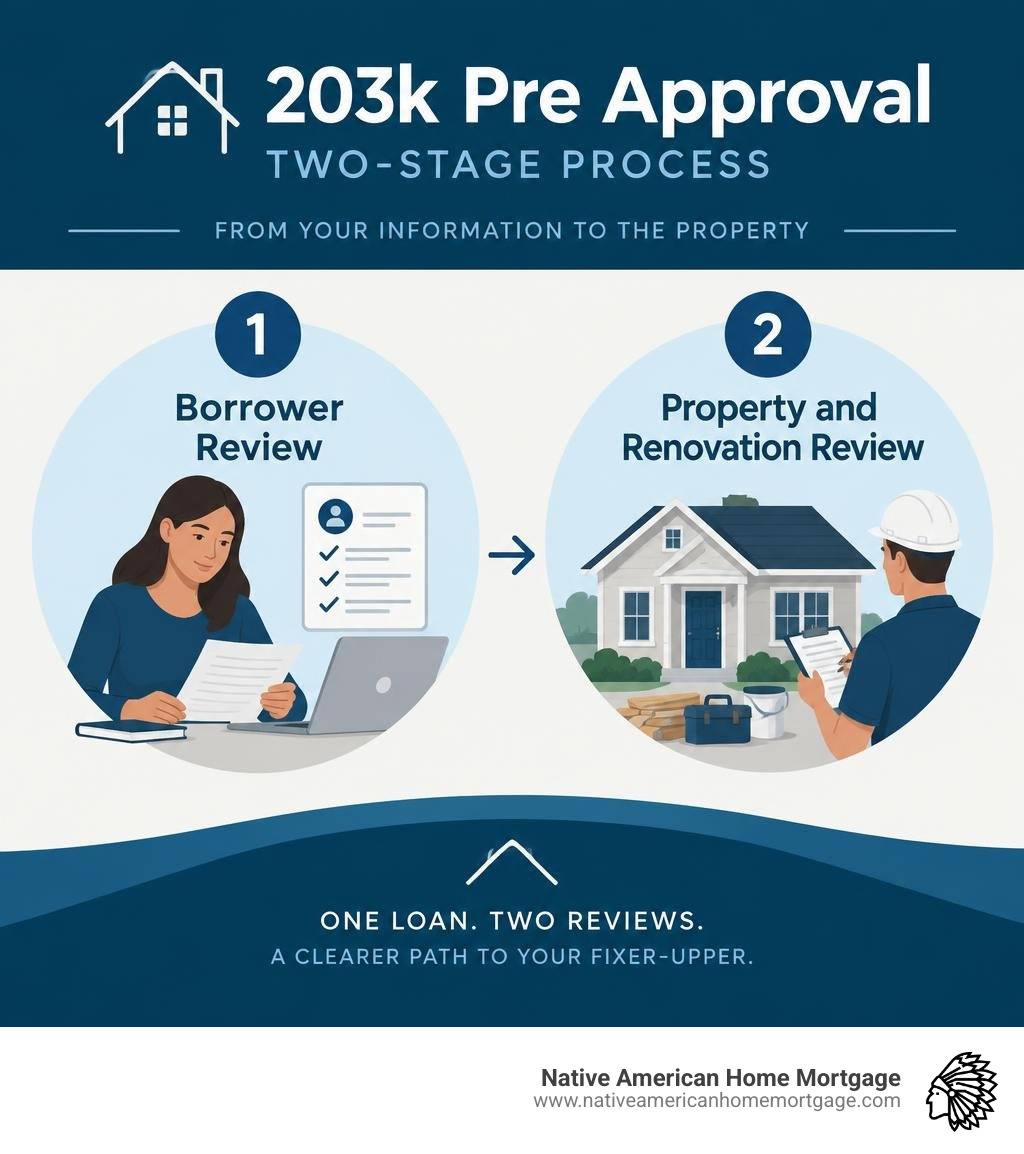
Pre-approval is not final loan approval. Once you identify a property, the lender must review detailed contractor bids, the renovation scope, and an appraisal of the home’s expected value after repairs. This extra stage is why a borrower can qualify for standard FHA financing but need more documentation for a 203(k).
I am Dale Gremillion, a Senior Loan Officer and Producing Branch Manager with more than 25 years in residential mortgage lending, including FHA and complex home-financing scenarios. I help borrowers understand the moving parts of 203k pre approval so they can prepare before a fixer-upper becomes a stressful surprise.
Understanding the 203k Pre Approval Process and Core Requirements
Financing a fixer-upper can feel overwhelming, but an FHA 203(k) mortgage simplifies the puzzle by rolling the property purchase price and repair costs into a single monthly payment. If you are comparing your options across different programs, exploring a practical guide to home financing options can help you determine how government-backed rehab loans align with your broader homeownership goals.
The 203(k) program is backed by the U.S. Department of Housing and Urban Development (HUD). Instead of forcing buyers to pay out-of-pocket for expensive repairs or take out high-interest personal loans, the mortgage establishes an escrow account. The lender places the rehabilitation funds into this escrow account at closing and disburses payments to licensed contractors as work milestones are verified and completed.
Pre-Qualification vs Formal 203k Pre Approval
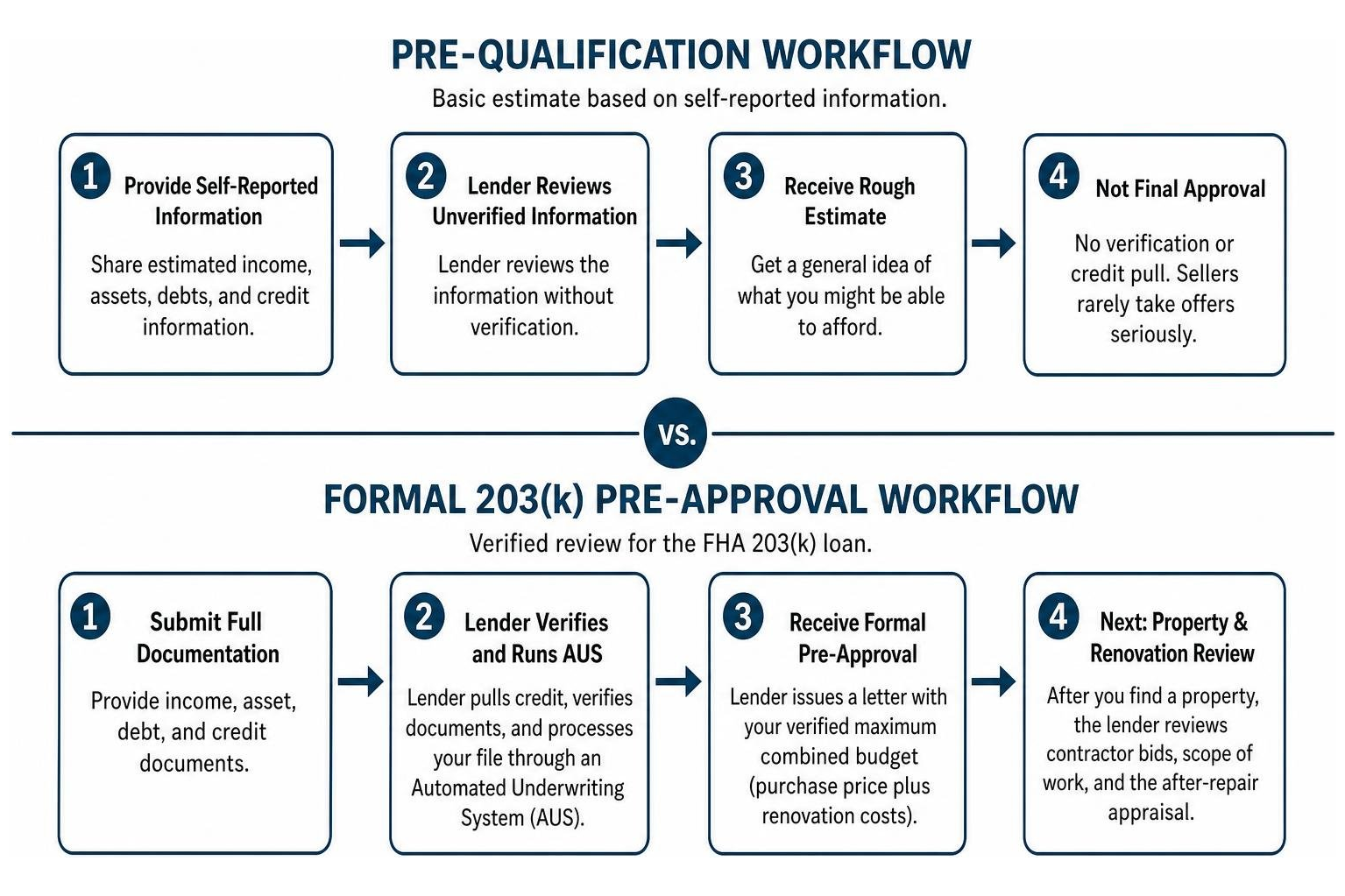
It is essential to understand the difference between a rough estimate and a verified pre-approval before touring prospective properties:
- Pre-Qualification: A basic estimate based on unverified, self-reported income, debt, and asset numbers. It provides a loose idea of what you might afford, but sellers rarely take offers seriously without formal verification.
- Formal 203(k) Pre-Approval: A comprehensive review where the lender runs a hard credit pull, processes your file through an Automated Underwriting System (AUS), and verifies pay stubs, W-2s, and bank statements. The lender then issues a formal letter stating your verified maximum combined budget (purchase price plus renovation costs).
Financial Criteria: Credit Score, Down Payment, and DTI
Qualifying for an FHA 203(k) follows standard FHA baseline rules, though individual lenders frequently apply extra requirements called overlays:
- Credit Score: The statutory FHA minimum is 580 to qualify for the standard 3.5% down payment. Borrowers with scores between 500 and 579 are technically eligible under HUD guidelines with a 10% down payment, but most lenders prefer a 620+ credit score for a Limited 203(k) and 640+ for a Standard 203(k). Some institutions set a firm floor of 660.
- Down Payment: The 3.5% down payment is calculated on the total combined project cost (purchase price + total repair costs + contingency reserves), not just the purchase price.
- Debt-to-Income (DTI) Ratio: HUD prefers a total DTI ratio of 43% or lower. However, higher DTIs can be approved if you have strong compensating factors, such as verified cash reserves, a long and stable employment history, or minimal payment shock.
If you are working on your financial profile, reviewing strategies for improving mortgage approval odds can help you secure better terms before applying.
Limited vs Standard 203(k) Renovation Loan Rules
The FHA 203(k) program comes in two distinct variations depending on the scope of work your property requires:
| Feature | Limited 203(k) (Streamline) | Standard (Full) 203(k) |
|---|---|---|
| Repair Budget Cap | Capped at $35,000 | No dollar cap (up to local FHA loan limits) |
| Minimum Repair Cost | None | $5,000 minimum |
| Eligible Repairs | Cosmetic, non-structural (paint, flooring, appliances, HVAC) | Major structural alterations, additions, full gut remodels |
| HUD Consultant Required? | No | Yes (oversees scope, inspections, and draws) |
| Contingency Reserve | Optional (typically 10% if required) | Mandatory 10% to 20% |
| Closing Timeline | 30–45 days | 45–60 days |
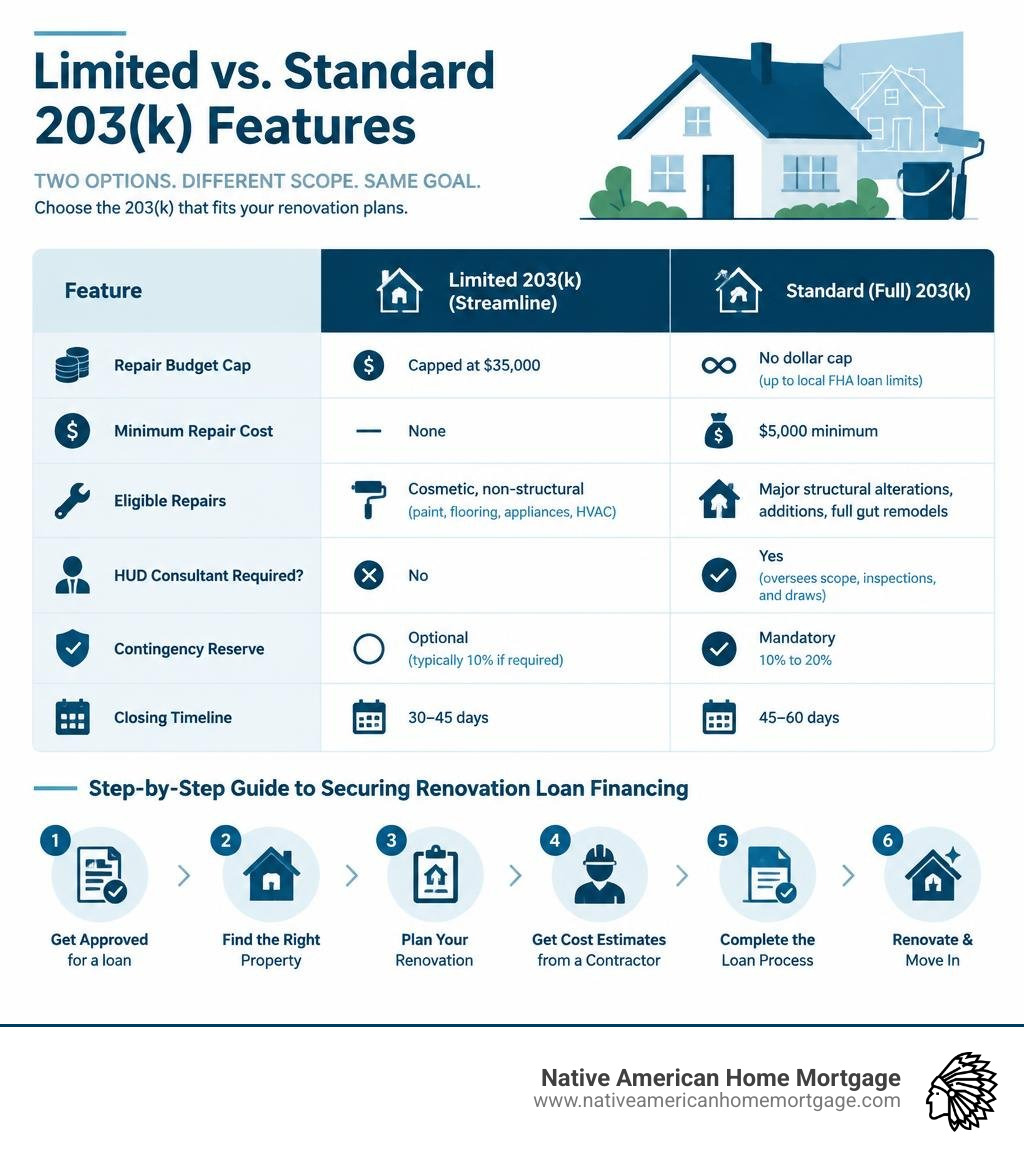
Step-by-Step Guide to Securing Renovation Loan Financing

Navigating a rehabilitation mortgage requires careful sequencing. The process moves from borrower approval to property selection and construction planning.
Stage One: Securing a 203k Pre Approval Before Property Search
During the initial phase, your lender determines your total borrowing capacity based on your household financials.
- Submit Financial Documents: Provide two years of tax returns, W-2s, 30 days of recent pay stubs, two months of asset statements, and identification.
- Review Borrowing Limits: Your lender checks local FHA loan limits for the county where you plan to buy. The sum of the home’s purchase price and renovation budget cannot exceed this limit.
- Calculate Maximum Financing: Lenders use specialized tools such as the HUD 203(k) calculator guidance to factor in base repair costs, contingency reserves, inspection fees, and supplemental origination fees (which cannot exceed the greater of $350 or 1.5% of total repair costs).
Stage Two: Property Selection, Contractor Bids, and Underwriting
Once you find a home needing work and have an accepted purchase contract, the renovation underwriting phase begins:
- Hire Licensed Contractors: The contractor must provide proof of licensing, liability insurance, references, and a fully itemized bid detailing labor, material costs, and permit fees. Self-help (DIY) work is heavily restricted and generally not permitted unless the borrower is a licensed professional contractor by trade.
- Feasibility & Consultant Report: For a Standard 203(k), a certified HUD consultant inspects the property to draft the formal Work Write-Up and draw schedule.
- As-Completed Appraisal: An FHA-approved appraiser evaluates the home and reviews the contractor’s bids to establish the home’s projected future market value after all renovations are finished.
- Escrow Setup and Closing: The loan closes, the seller receives payment for the purchase price, and the repair funds are locked in an escrow account. Repairs must begin within 30 days of closing and be fully finished within six months.
Eligible tribal members comparing renovation options can also explore Native-focused options like Native American home loan approval or tribal programs when assessing rehabilitation paths.
Why Standard FHA Approval Differs from 203(k) Financing

Borrowers are sometimes surprised to discover that a pre-approval for a standard FHA loan does not automatically guarantee qualification for an FHA 203(k) loan.
Lender Overlays and Inexperience Hurdles
Only about 30% of FHA-approved lenders actively offer and process 203(k) loans. Because renovation loans involve construction risk, escrow management, and contractor draw schedules, many lending institutions enforce strict internal rules (lender overlays):
- Higher Credit Minimums: While a standard FHA loan may allow a 580 score, the same lender might require a 640 or 660 for a 203(k).
- Interest Rate Variations: Pricing can vary by up to 0.50% between lenders for renovation loans. On a $400,000 mortgage, that 0.50% difference equals approximately $44,000 in additional interest over a 30-year term.
- Loan Officer Familiarity: Inexperienced loan officers may struggle with project coordination, leading to unexpected underwriting denials or extended closing delays.
Borrowers wanting to examine official rules can review the HUD 203(k) Rehabilitation Mortgage Insurance Program guidelines for comprehensive program specifications.
Specialized Documentation and Consultant Inspections
Standard purchases only evaluate the borrower’s income and the home’s current condition. A 203(k) loan requires an entire secondary underwriting review focused on construction feasibility:
- Detailed architectural exhibits and environmental permits.
- Contractor background packages (W-9, liability coverage, workers’ compensation).
- Formal draw schedules defining when escrow funds will be disbursed after passed inspections.
- Mandatory HUD completion certificates upon project finish.
Frequently Asked Questions About Renovation Mortgages
Can I get pre-approved for a 203(k) loan before finding a contractor?
Yes. Your initial pre-approval evaluates your creditworthiness, income, assets, and maximum total budget. You do not need a specific property or contractor bid to receive a pre-approval letter stating your maximum total purchase-and-renovation purchasing power. You will select your contractor and finalize project bids once your purchase offer on a home is accepted.
How long does the 203(k) pre-approval and closing timeline take?
The initial borrower pre-approval takes 1 to 3 business days once you submit all required income and credit documentation. However, closing on the home takes longer than a traditional purchase:
- Limited 203(k): Typically closes in 30 to 45 days.
- Standard 203(k): Typically closes in 45 to 60 days due to the added HUD consultant feasibility study, detailed contractor bids, and specialized as-completed appraisal.
What happens if the renovation costs exceed my initial pre-approval?
If contractor bids come back higher than your approved loan ceiling, you have three primary options:
- Reduce Project Scope: Scale back non-essential cosmetic updates while keeping mandatory safety and structural repairs intact.
- Increase Down Payment: Pay the difference out-of-pocket at closing to keep the loan amount within approved lending limits.
- Re-Qualify for a Higher Balance: If your income and DTI ratios permit, ask your loan officer to re-underwrite your application for a higher total mortgage amount.
Conclusion
An FHA 203(k) loan is one of the most powerful tools available to turn an affordable fixer-upper into your dream home while building instant equity. Navigating the program requires partnering with a lender that understands the specialized escrow guidelines, contractor requirements, and appraisal standards.
When you are ready to begin, our team can guide you through the process. Explore our detailed guide on navigating the 203k FHA loan or contact Native American Home Mortgage today to start your pre-approval journey.