Is a Single Close Construction to Permanent Loan Right for Your Build?
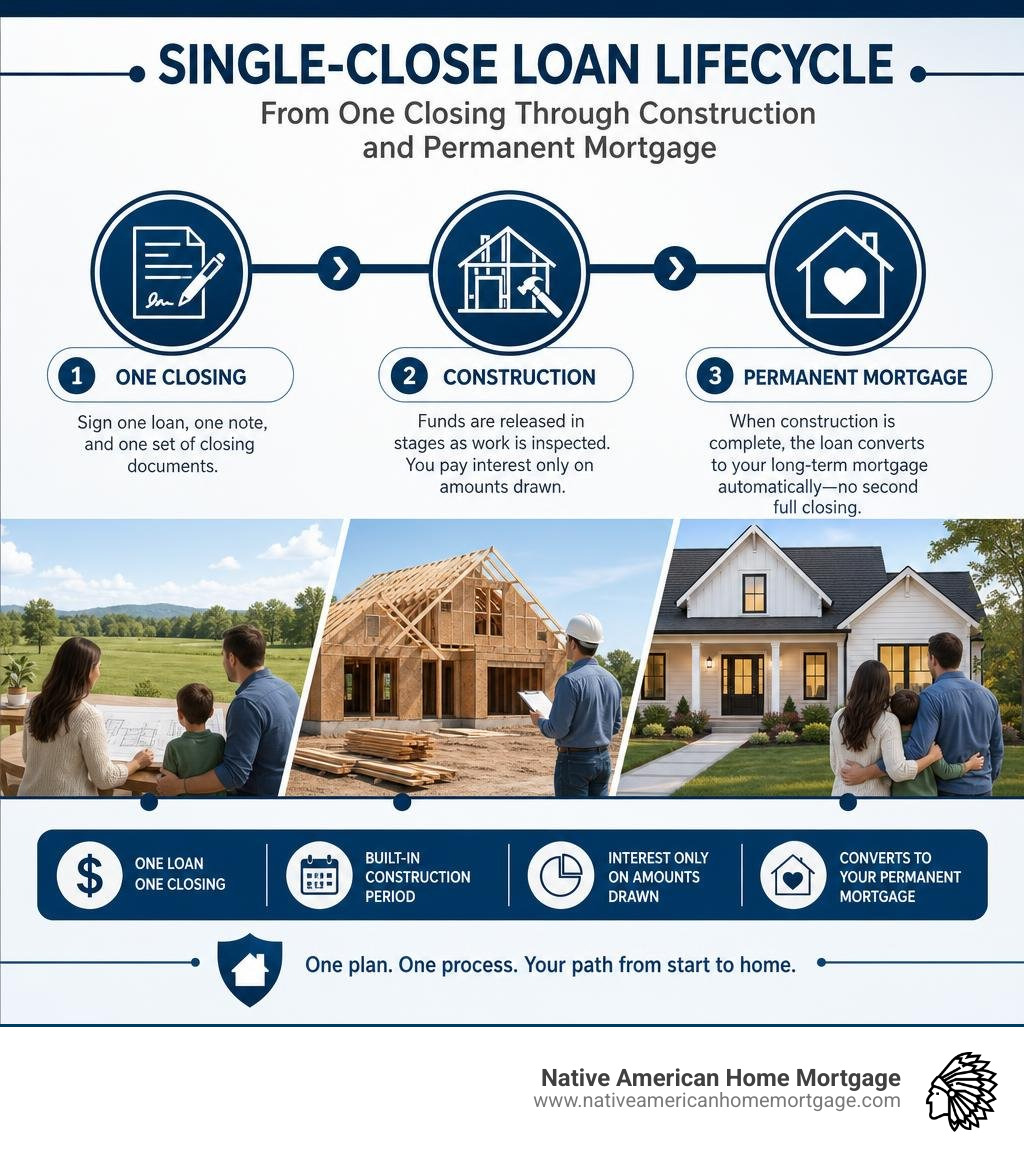
A single close construction to permanent loan combines land purchase or existing-land financing, home construction, and the long-term mortgage into one loan with one closing. During construction, funds are released in stages as work is inspected, and you generally pay interest only on the money drawn. Once the home is complete, the loan converts to the permanent mortgage without a second full closing.
This option may be a strong fit if you want to:
- Avoid a second set of closing costs and a second mortgage application.
- Know your permanent financing plan before building starts.
- Build on land you are buying or already own.
- Use an eligible low-down-payment program, such as FHA, VA, USDA, or certain conventional options.
The trade-off is that the project, builder, budget, and timeline must meet lender rules upfront. For conventional single-close transactions, construction generally cannot exceed 18 months total, and no construction period can be longer than 12 months. A delayed build, unsupported cost overrun, expired income documents, or a lower-than-expected completed appraisal can complicate conversion.
I am Dale Gremillion, a Senior Loan Officer and Producing Branch Manager with more than 25 years in residential mortgage lending, including Conventional, FHA, HUD 184, VA, and USDA financing. I help borrowers evaluate whether a single close construction to permanent loan fits their land, builder, budget, and long-term homeownership goals.
What Is a Single Close Construction to Permanent Loan and How Does It Work?
A single-close construction-to-permanent loan (also referred to as an “all-in-one” or “one-time close” loan) merges interim construction funds and long-term permanent financing into a single legal instrument. Instead of securing a short-term construction loan from a local bank and later shopping for a standard 30-year fixed mortgage, you sign one promissory note and one mortgage or deed of trust at the outset.
During the building phase, your lender creates a dedicated escrow account. The general contractor requests incremental disbursements, called “draws,” according to a pre-approved schedule aligned with project milestones. As work progresses, the lender sends a third-party inspector to confirm completed work before releasing funds.
Because you only pay interest on the money disbursed, your monthly carrying costs remain manageable while the structure takes shape. After receiving the Certificate of Occupancy and completing final inspections, the interim construction loan automatically modifies or rolls into a permanent, amortizing mortgage.
| Feature | Single-Close Construction-to-Permanent Loan | Traditional Two-Close Construction Loan |
|---|---|---|
| Closings Required | One closing before excavation begins | Two separate closings (construction & permanent) |
| Closing Costs | Single set of lender, legal, and title fees | Duplicate loan fees, legal fees, and title insurance |
| Underwriting Steps | One upfront qualification cycle | Full requalification required at project completion |
| Interest-Rate Risk | Rate locked upfront or secured via forward lock | Subject to market rate changes at take-out |
| Take-Out Risk | Eliminated; permanent note in place from Day 1 | High; job changes or valuation drops jeopardize loan |
| Maximum Build Time | Capped at 18 months total (12-month segments) | Dictated by short-term note maturity (often 12 mos) |
Single-Close vs. Two-Close Financing Mechanics
The primary structural benefit of a single-close loan is the elimination of take-out financing risk. In a traditional two-close arrangement, a borrower secures a standalone short-term construction facility. When the build is finished, that temporary loan matures, requiring the borrower to apply for an entirely new permanent mortgage to pay off the builder note.
If during the 12 to 14 months of construction you switch jobs, take on new debt, experience an interest rate spike, or see local home values soften, your permanent take-out loan might get denied. You could be left holding a matured short-term loan on an unfinished or newly finished home.
A single-close loan removes this exposure through a single upfront underwriting event. Both the interim draw structure and the 30-year permanent financing are fully approved before the first foundation trench is dug.
Moreover, avoiding a second closing saves borrowers substantial money. On standard custom builds, duplicate loan origination charges, settlement fees, double appraisal management, and redundant title insurance policies can add up quickly. Borrowers regularly save anywhere from $25,000 to $90,000 in redundant settlement costs, transfer charges, and bridge carrying expenses across the lifetime of the project. To see how these mechanics fit into your complete financing plan, explore The Ultimate Guide to Construction to Permanent Loans.
The Recourse Shift and Conversion Triggers
Beyond consumer cost savings, single-close financing structures offer clear operational protections through what commercial and residential underwriters call the “recourse shift.”
During the active building phase, the loan operates under strict recourse terms. The general contractor and borrower must meet standard build warranties, construction timelines, and performance covenants. If the project stalls or the builder abandons the site, full financial accountability rests on the borrowing parties.
Once the home crosses the finish line, the loan converts to standard permanent terms governed by conforming guidelines. In commercial and multifamily builds, this marks the transition to non-recourse terms backed only by standard bad-boy carve-outs (fraud, gross negligence, or environmental non-compliance). In residential lending, the transition removes interim construction risk, transforming the loan into an ordinary single-family mortgage.
To execute this transition without friction, the lender verifies specific milestones:
- Issuance of the final Certificate of Occupancy (CO) from the local building department.
- A clean, unencumbered title date-down endorsement verifying that no mechanic’s liens or vendor claims exist.
- Signed, unconditional final lien waivers from the primary builder, trade contractors, and Tier-2 material suppliers.
- Completion of the property in strict compliance with the original architectural plans and specifications.
For an exhaustive breakdown of secondary market rules governing conversion mechanisms, review the official policy updates in Conversion of Construction-to-Permanent Financing: Single-Closing Transactions | Fannie Mae.
Eligibility Requirements, Loan Programs, and Down Payment Options

A single-close construction loan can finance a broad range of residential builds. Eligible structures include traditional site-built (“stick-built”) homes, factory-built modular structures, manufactured homes affixed to a permanent foundation, and detached site condominiums. Multi-unit configurations (such as duplexes and 4-unit properties) can also qualify under standard agency rules, provided the borrower intends to occupy at least one unit as their primary residence.
Qualifying for a Single Close Construction to Permanent Loan
Qualifying for a single-close loan requires evaluating both your personal finances and the credentials of your builder:
- Credit Profile: Conventional single-close guidelines generally require a credit score of 680 or higher, while government-backed options (such as FHA) permit scores down to 620. If you are working to optimize your credit profile before submitting plans, take time to review Native American Mortgage Approval Odds and How to Improve Them.
- Debt-to-Income (DTI) Ratios: Automated underwriting systems generally cap back-end DTI at 45% for conventional builds, though government single-close programs can accept DTI ratios up to 50% with strong compensating factors.
- Income Stability: Lenders require standard two-year employment histories with verifiable W-2s, 1099s, or corporate tax returns.
- General Contractor Approval: The lender must thoroughly review the general contractor before clearing the loan to close. This includes evaluating the builder’s commercial liability insurance, workers’ compensation coverage, state licensure, references from prior custom builds, and financial balance sheets. Owner-builder arrangements (where the borrower acts as their own general contractor) are generally restricted or disallowed under single-close guidelines.
Government-Backed and Specialized Program Features
Depending on your financial profile, military service, geographic location, or heritage, several distinct single-close options are available:
- FHA One-Time Close: Features a low 3.5% down payment and allows credit scores down to 620. Borrowers can carry a debt-to-income ratio up to 50%, making custom builds accessible to first-time buyers with smaller cash reserves.
- VA Single-Close Construction Loan: Eligible active-duty service members, veterans, and surviving spouses can build a custom home with 0% down payment and no monthly private mortgage insurance (PMI), up to applicable county limits.
- USDA Single-Close Loan: Designed for rural communities, this program allows 100% financing (0% down) on primary residences built in designated rural zones.
- HUD Section 184 Indian Housing Loan Guarantee: Tailored for enrolled members of federally recognized American Indian tribes and Alaska Natives, this program supports construction on fee-simple, tribal trust, and allotted land. It requires just 2.25% down on loans over $50,000 (and 1.25% on smaller loans). Eligible borrowers can review our detailed guide on Demystifying Section 184 Your Path to Affordable Tribal Homeownership or reference the federal Section 184 Indian Home Loan Guarantee Program – HUD standards.
Underwriting Guidelines: LTV Calculation, Credit Expiration, and Rate Locks
Accurately calculating your loan-to-value (LTV) ratio depends on whether you are acquiring land as part of the transaction or building on a parcel you already own.
Purchase vs. Refinance LTV Rules
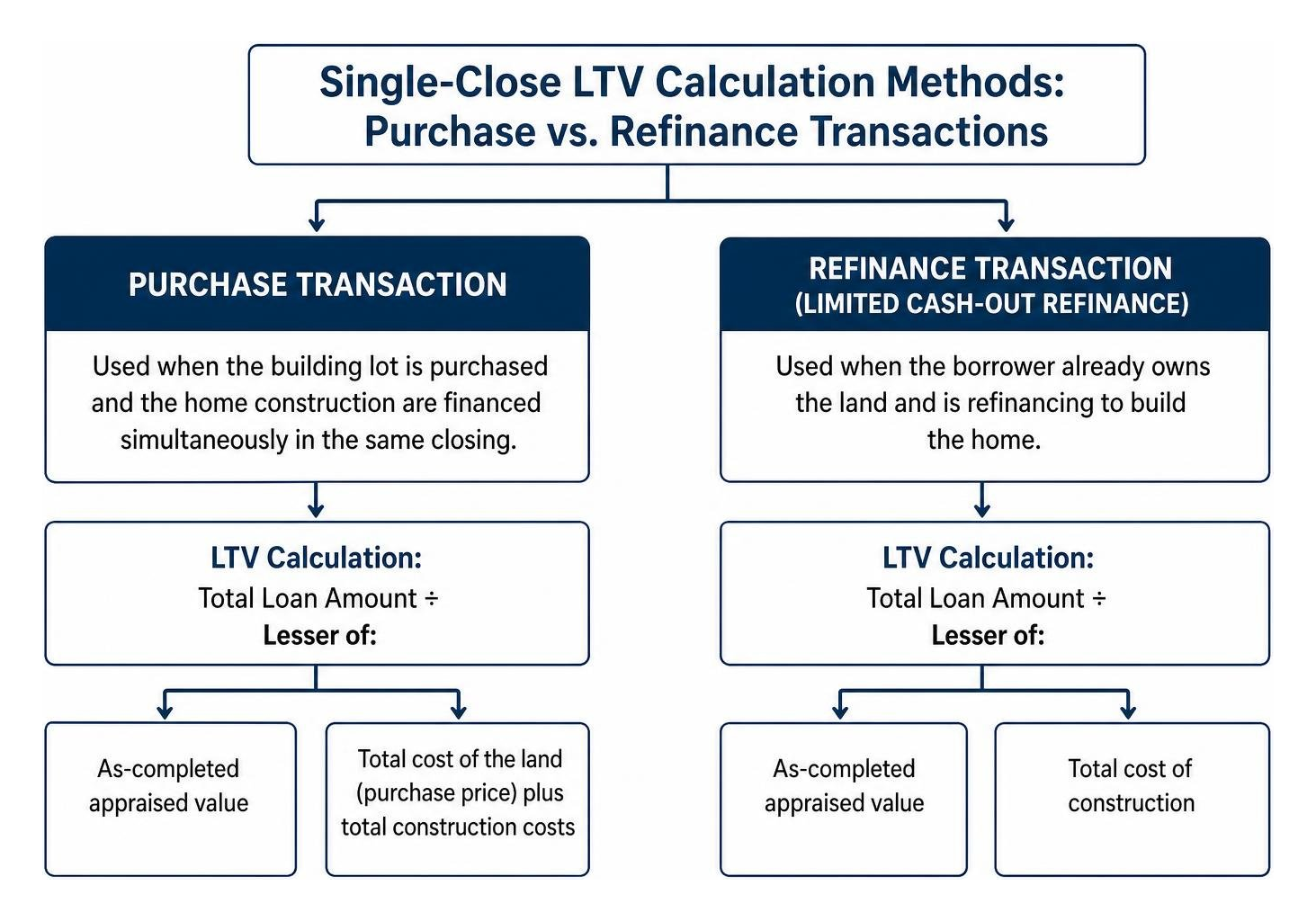
Under agency guidelines (Fannie Mae and Freddie Mac), single-close transactions are classified as either a purchase or a Limited Cash-Out Refinance (LCOR):
- Purchase Transaction: Applied when you purchase the building lot and finance the home construction simultaneously within the same closing. In this scenario, the LTV is calculated by taking the total loan amount divided by the lesser of:
- The total documented acquisition cost (Purchase price of the vacant land + full construction contract cost + legitimate soft costs).
- The “as-completed” appraised value determined by a certified appraiser reviewing the plans, specs, and interior finishes.
- Limited Cash-Out Refinance (LCOR): Applied when you already hold legal title to the land before the initial loan closing. Here, the LTV is simply the total loan amount divided by the “as-completed” appraised market value. The equity in your land acts as your down payment credit. If you own the parcel free and clear, that unencumbered value can satisfy your entire down payment requirement.
To ensure your loan file passes Desktop Underwriter (DU) without processing errors, mortgage underwriters rely on formal technical criteria found in DU Job Aids: Construction-To-Permanent Transactions. If you are structuring a custom build in the Southwest, reference Arizona Construction Loans 101 Financing Your Desert Oasis for regional underwriting insights.
Managing Document Expiration for a Single Close Construction to Permanent Loan
Because building a home takes months, initial loan documentation will age during the project. Under standard mortgage guidelines, credit reports, paystubs, and asset statements expire after 120 days (4 months).
However, Fannie Mae and Freddie Mac offer an important administrative rule for single-close loans: The 18-Month Documentation Exception.
If your loan met the following conditions at initial closing:
- Delivered an automated “Approve/Eligible” recommendation through Desktop Underwriter, and
- Maintained an LTV/CLTV/HCLTV ratio of 95% or lower,
the lender is not required to pull updated income, asset, or credit documents at final conversion, even if the build takes up to 18 months.
If your initial LTV exceeded 95%, or if you make major changes to the project that require re-underwriting (such as taking on secondary financing or significantly altering loan terms), you must supply refreshed paystubs, asset verifications, and credit pulls before the permanent conversion rider can be executed.
Required Inspections, Timelines, and Avoiding Conversion Failure

A single-close construction-to-permanent loan must follow clear milestone schedules to prevent delays that could jeopardize loan delivery to the secondary mortgage market.
Under conventional guidelines, the maximum allowable construction window is 18 months total, structured in distinct performance phases that cannot exceed 12 months individually.
Construction Milestones and Form 1004D Completion
During construction, the lender manages risk through a structured inspection and draw schedule:
- Draw Inspections: Before each progress payment is wired to the builder, a third-party inspector inspects the job site to confirm that the requested stage (e.g., foundation, framing, rough MEP, drywall, trim) is fully completed.
- Title Date-Down Endorsement: Alongside draw inspections, the settlement agent performs title date-down checks to verify that no suppliers or subcontractors have placed a lien on the property.
- Appraisal Update and Completion Report (Fannie Mae Form 1004D / Freddie Mac Form 442): Once work is finished, the original appraiser visits the completed home. They verify that the property matches the original architectural blueprints and specifications, confirm all utilities are active, and verify that the market value has not declined.
- Substantial Completion Verification: Architects and project managers verify completion using industry standards such as the AIA Document G704 (Certificate of Substantial Completion).
For more details on managing post-closing project modifications and delivery criteria, consult FAQs: Construction-to-Permanent Financing | Fannie Mae.
Common Conversion Pitfalls and How to Prevent Them
Even with an upfront single-close approval, things can go wrong if you don’t manage the build carefully. Here are the most common issues that can stall a loan conversion:
- Unapproved Change Orders: Requesting structural changes, custom upgrades, or floor plan modifications without formal lender approval can inflate construction costs beyond the escrow balance. Keep change orders documented, signed, and approved by the lender.
- Tier-2 Subcontractor Liens: A general contractor might receive draw funds but fail to pay lumber yards, roofers, or concrete suppliers. Unpaid suppliers can file mechanic’s liens, which halts conversion until the dispute is resolved. Require signed lien waivers from all subcontractors and suppliers with every draw.
- Reimbursement for Self-Financed Cost Overruns: If an overrun occurs and you pay out-of-pocket, agency guidelines prohibit reimbursing you through a Limited Cash-Out Refinance at conversion. Any cash back to the borrower triggers Cash-Out Refinance rules, requiring a 6-month land title-hold period and a restructuring into a two-close loan.
- Appraisal Valuation Declines: If local home prices decline during a long build, the Form 1004D completion report might reflect a lower value than the original “as-completed” appraisal. If the lower value pushes your LTV above program limits, you may need to make a cash principal reduction before the mortgage can convert.
To review borrowing limits, down payments, and debt-to-income benchmarks before you finalize your architectural plans, use our interactive tool to Calculate Your Home Loan Eligibility in Seconds.
Frequently Asked Questions About Single-Close Construction Financing
What happens if construction exceeds the 18-month time limit?
If severe weather, supply chain disruptions, or contractor disputes push your construction beyond the 18-month maximum, the loan loses its single-close eligibility under standard agency guidelines.
When this happens, the loan cannot automatically convert to permanent financing. The lender must modify the transaction into a short-term construction bridge loan, requiring you to restructure and complete a separate permanent refinance (effectively turning it into a two-close transaction).
To prevent this, request formal construction schedule extensions with your lender well before reaching the 12- or 18-month deadlines.
Can I lock my permanent interest rate before construction starts?
Yes. Many lenders offer a long-term forward rate-lock specifically designed for single-close construction loans.
These agreements lock your permanent mortgage interest rate for 12, 18, or 24 months. They generally require an upfront lock fee ranging from 0.50% to 1.50% of the loan amount, which is often credited back toward closing costs or principal once the home converts.
Many forward locks also include a “float-down” option, allowing you to secure a lower interest rate if market rates drop during your build.
Are manufactured and modular homes eligible for single-close financing?
Yes. Both modular and factory-built manufactured homes qualify for single-close construction-to-permanent financing under Fannie Mae (Selling Guide B5-2-03), FHA, VA, and HUD Section 184 guidelines.
The loan can finance the land purchase, initial site preparation (excavation, well, septic, foundation), delivery fees, and permanent affixation to an engineered foundation system. The home must be classified as real property under state law and cannot be located on leased land or within a mobile home park.
Conclusion
Building a custom home offers unmatched personalization, but managing two separate loans, double closing fees, and market volatility can add unnecessary stress. A single-close construction-to-permanent loan streamlines this process by combining land acquisition, construction draws, and your 30-year permanent mortgage into a single transaction.
By partnering with a licensed general contractor, securing your permanent interest rate early, and maintaining organized draw records, you can keep your custom build on track from excavation to move-in day.
Whether you are building a stick-built home in a suburban subdivision, an off-grid custom build in the high desert, or a multi-generational home on tribal land, our team can help you navigate the process. Visit Native American Home Mortgage or review The Ultimate Guide to Construction to Permanent Loans to discuss your project plans and take the first step toward building your home.