The Homeownership Gap Facing Native American First Time Home Buyers
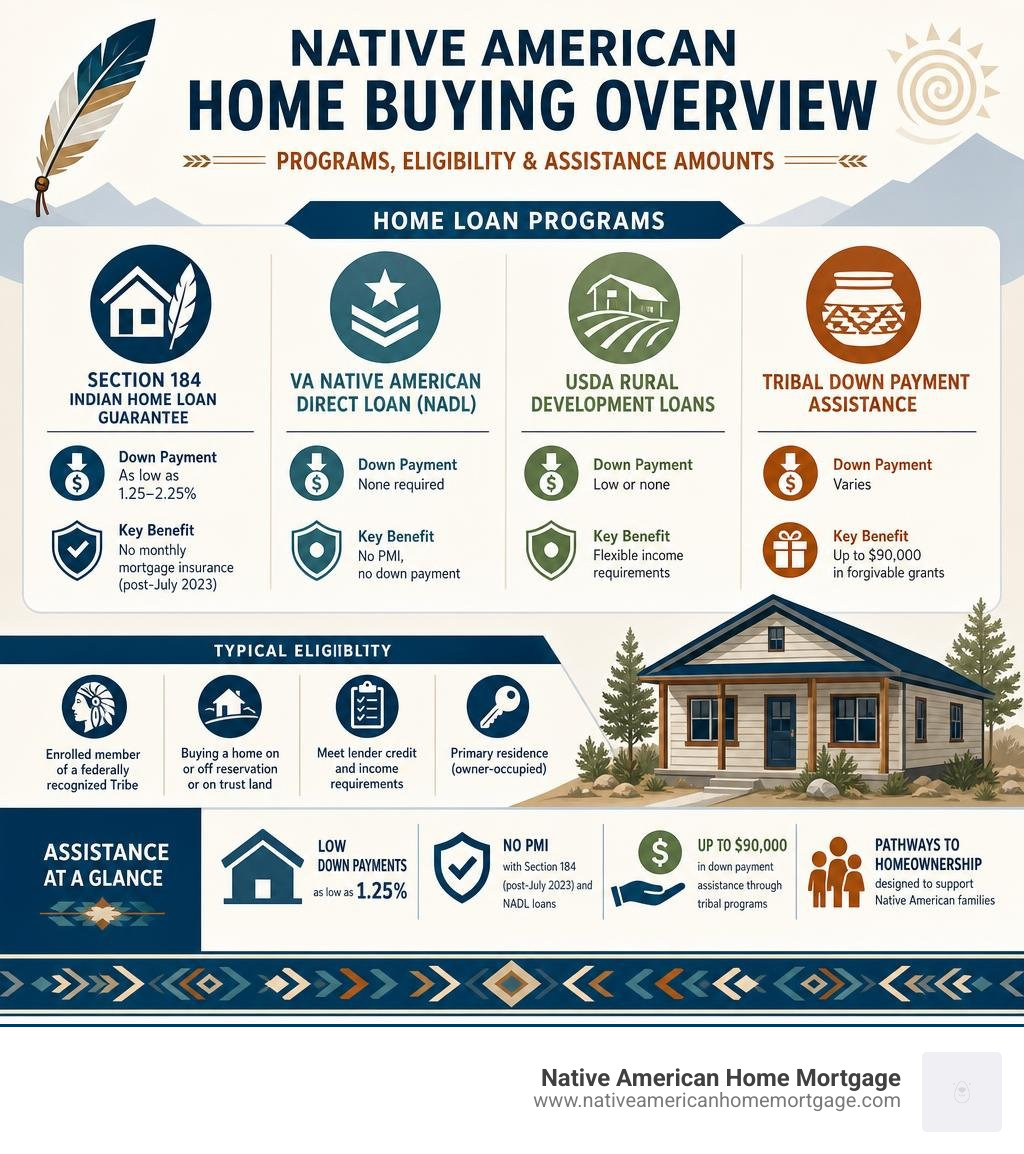
Native American first time home buyers have access to powerful loan programs — but most never hear about them. Here’s a quick summary of what’s available:
| Program | Best For | Down Payment | Key Benefit |
|---|---|---|---|
| Section 184 Indian Home Loan Guarantee | Tribal members buying on or off reservation | As low as 1.25–2.25% | No monthly mortgage insurance (post-July 2023) |
| VA Native American Direct Loan (NADL) | Native veterans buying on trust land | None required | No PMI, no down payment |
| USDA Rural Development Loans | Rural Native buyers | Low or none | Flexible income requirements |
| Tribal Down Payment Assistance | First-time buyers with tribal membership | Varies | Up to $90,000 in forgivable grants |
The reality is this: Native Americans own homes at a rate of about 56% — roughly 15 percentage points below the national average. In five states, that gap widens to more than 30 percentage points. On tribal lands, nearly 16% of households live in overcrowded conditions, compared to just 2.2% nationally.
These aren’t just statistics. They reflect real families who want to own a home but keep running into walls — lenders who don’t understand tribal land, programs they’ve never been told about, and a mortgage system that wasn’t designed with Native communities in mind.
This guide changes that.
I’m Dale Gremillion, a Senior Loan Officer (NMLS #210325) with over 20 years of mortgage experience, specializing in helping Native American first time home buyers navigate the Section 184 Indian Home Loan Guarantee Program and other tribal lending solutions. I’ve spent my career cutting through the confusion so that tribal members can access the homeownership opportunities they’ve always deserved.
Barriers Facing Native American First Time Home Buyers

When we look at why the homeownership gap persists, we have to talk about the systemic hurdles built into the lending process. For many native american first time home buyers, the path to buying a home is paved with unexpected roadblocks.
One of the most significant barriers is credit access and loan pricing. A groundbreaking Minneapolis Fed study on mortgage disparities revealed that Native American borrowers on reservations pay, on average, a 197 basis point higher rate spread than White borrowers. That is nearly a full two percentage points more in interest costs!
What is even more striking is that off-reservation Native borrowers face a 23 basis point higher rate spread. Only 16% of the on-reservation price gap can be explained by standard applicant characteristics like credit scores and property values, compared to 67% for off-reservation loans. This means that traditional underwriting systems fail to account for the unique financial realities of tribal communities, leading to higher mortgage denial rates and inflated pricing.
Furthermore, the process of securing a mortgage on reservation land is notoriously slow. Conditional on loan approval, on-reservation Native mortgages take 23 days longer to originate than White mortgages. If you are buying a manufactured home, on-reservation Native home-only loans take an additional 37 days to originate compared to White home-only loans. These delays often cause purchase agreements to fall through, leaving families stranded in overcrowded or substandard housing.
Federal Mortgage Programs for Native American First Time Home Buyers

The federal government has established specialized mortgage programs designed to bypass these traditional credit hurdles. If you are a first-time buyer in our operating states of Arizona, New Mexico, Utah, or Colorado, understanding these programs is your ticket to affordable homeownership.
Section 184 Indian Home Loan Guarantee Program
The premier federal program for Native buyers is the Section 184 Indian Home Loan Guarantee Program. Established by Congress in 1992, this program addresses the lack of private mortgage capital on reservation lands by providing a 100% federal guarantee to lenders. This guarantee means we can offer highly competitive, market-rate financing without charging astronomical risk premiums.
Here are the key details you need to know about the Section 184 program:
- Tribal Enrollment: You must be an enrolled member of a federally recognized tribe to qualify.
- Down Payment: Down payments are incredibly low. For loans over $50,000, the minimum down payment is just 2.25%. For loans under $50,000, it drops to 1.25%.
- No Monthly Mortgage Insurance: For all Section 184 loans closed after July 1, 2023, HUD eliminated the monthly mortgage insurance premium. You only pay a one-time 1.0% upfront guarantee fee which can be rolled into the loan amount. This saves borrowers hundreds of dollars every single month compared to conventional or FHA loans!
- Loan Limits: The program uses standard HUD county loan limits. In most parts of our Southwestern operating footprint, the standard one-unit limit is $832,750, with high-balance areas extending up to $1,249,125.
- Eligible Uses: You can use a Section 184 loan to buy an existing home, build a new home, rehabilitate an existing property, or refinance your current mortgage.
For a deeper dive into underwriting rules, you can review the official Section 184 HUD Guidelines.
VA Native American Direct Loan (NADL) for Veterans
If you are a Native American veteran or service member looking to purchase a home on tribal trust land, the VA Native American Direct Loan (NADL) program is an extraordinary benefit. Unlike traditional VA loans where a private lender provides the funds, the VA acts as the direct lender for the NADL program.
Key benefits of the NADL program include:
- Zero Down Payment: You can finance up to 100% of the home’s value.
- No Private Mortgage Insurance (PMI): You save significantly on your monthly payment since PMI is not required.
- Trust Land Access: The program is specifically designed for building, purchasing, or improving homes located on federal trust land.
- Low Closing Costs: The VA limits the closing costs lenders can charge, keeping more cash in your pocket.
To utilize this program, your tribe must have a memorandum of understanding (MOU) with the VA. You can find more information through the BIA Mortgage Assistance for Veterans portal.
Navigating Tribal Trust Land vs. Fee-Simple Land
One of the most complex aspects of buying a home in the Southwest is navigating land status. In states like Arizona, New Mexico, Utah, and Colorado, property is generally categorized as either tribal trust land or fee-simple land. Understanding this distinction is crucial for a smooth loan process.
To help you visualize the differences, we have broken down the key characteristics of each land type:
| Feature | Tribal Trust Land | Fee-Simple Land |
|---|---|---|
| Ownership | Owned by the federal government in trust for the tribe; cannot be sold. | Owned completely by the individual; can be bought and sold freely. |
| Collateral Method | Leasehold Mortgage (typically a 50-year lease). | Standard Deed of Trust / Mortgage. |
| BIA Involvement | Requires Bureau of Indian Affairs (BIA) approval and a Title Status Report (TSR). | No BIA involvement required. |
| Foreclosure Process | Subject to tribal ordinances; the land itself cannot be foreclosed on, only the leasehold interest. | Standard judicial or non-judicial foreclosure on land and home. |
| Lender Availability | Limited to specialized lenders who understand trust transactions. | Widely available through all traditional lenders. |
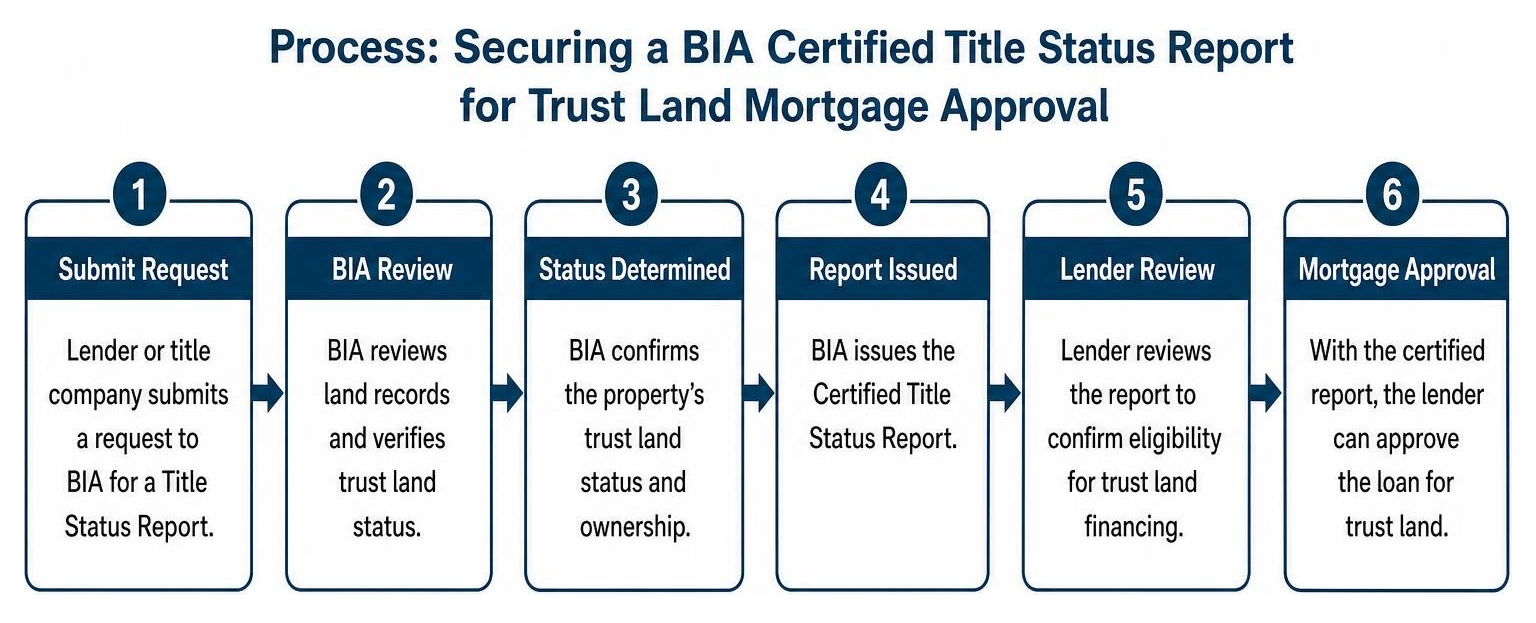
Buying on tribal trust land requires a leasehold mortgage. The tribe leases the home site to the buyer (usually for 50 years), and the buyer mortgages the leasehold interest. Because the land cannot be sold or alienated, the BIA must issue a Certified Title Status Report (TSR) both before the loan closes and after it is recorded. This added layer of bureaucracy is why trust land mortgages take longer to close, but specialized lenders like us are experts at navigating this pipeline.
Down Payment Assistance and Tribal Housing Programs
One of the biggest misconceptions among native american first time home buyers is that they must save up tens of thousands of dollars on their own to afford a home. In reality, there is a robust network of tribal housing programs and federal grants designed to bridge the financial gap.
Under the Native American Housing Assistance and Self-Determination Act (NAHASDA) of 1996, tribes receive Indian Housing Block Grants (IHBG). These funds are administered by Tribally Designated Housing Entities (TDHEs) to create affordable housing opportunities, including down payment assistance (DPA) grants.
To prepare yourself for the financial and emotional journey of homeownership, we highly recommend reviewing the Pathways Home Guide, which is the industry-standard curriculum for Native homebuyer education.
Down Payment Assistance Programs for Native American First Time Home Buyers
Across the United States, there are dozens of specialized DPA programs designed specifically for Native American buyers. These programs offer:
- Substantial Grant Amounts: Assistance ranges from $2,125 up to $90,000 depending on the tribe, location, and funding availability.
- Forgivable Terms: Many of these programs offer fully forgivable assistance. For example, if you live in the home as your primary residence for a set period (often 5 to 10 years), the down payment loan is completely forgiven and turned into a grant.
- Income Limits: While some programs have no income limits, many are designed to serve households earning between 80% and 120% of the Area Median Income (AMI).
- Flexible Property Types: Most programs allow the purchase of single-family homes, and many also permit modular or manufactured homes.
Because these programs are highly localized, you should contact your specific tribal housing authority or explore resources on the BIA Mortgage Assistance for Tribes and Individuals page to see what programs are active in Arizona, New Mexico, Utah, or Colorado.
The Role of Tribal Housing Entities and Credit Programs
Tribally Designated Housing Entities (TDHEs) and tribal credit divisions play a massive role in making homeownership a reality. Many Southwestern tribes—such as the Southern Ute Indian Tribe in Colorado or various Pueblos in New Mexico—run localized housing programs.
For example, tribal credit programs often offer unique “Secure Home Loan” options that allow members to purchase new or existing modular and manufactured homes on both trust and fee lands. These programs operate with a coordinated team consisting of the Tribal Credit Division, Tribal Housing, and the Lands Division to streamline the land leasing and home-matching process.
Manufactured Homes: Home-Only Loans vs. Traditional Mortgages
Manufactured housing is an incredibly popular and affordable housing option on reservations. In fact, according to the Minneapolis Fed, on-reservation Native borrowers are 12 times more likely to purchase a manufactured home compared to White borrowers.
However, how you finance a manufactured home makes a massive difference in your long-term financial health. Native borrowers are 30 percentage points more likely to apply for home-only (chattel) loans compared to White manufactured home buyers, even when controlling for local county factors.
Why is this a problem?
- Higher Interest Rates: Home-only loans (where you finance only the physical structure, not the land) carry significantly higher interest rates than traditional mortgages. This contributes directly to the high rate spreads paid by Native families.
- Slower Origination: Even though home-only loans are marketed as “faster” than mortgages, on-reservation Native home-only loans actually take an average of 37 additional days to originate compared to White home-only loans.
- Fewer Protections: Chattel loans do not offer the same consumer protections, refinancing flexibility, or equity-building potential as traditional real estate mortgages.
The good news is that you do not have to settle for a costly home-only loan. Under Section 184 guidelines, manufactured and modular homes can be financed with a standard, low-interest mortgage. To qualify, the manufactured home must be built after June 15, 1976, be permanently affixed to a foundation, have its title de-titled (converted to real property), and meet minimum size requirements (typically at least 570 square feet of living space).
By structuring your manufactured home purchase as a traditional mortgage rather than a chattel loan, you can save tens of thousands of dollars over the life of your loan. You can read more about this in the Minneapolis Fed research on manufactured home financing.
Frequently Asked Questions
What are the credit requirements for native american first time home buyers?
While conventional mortgages rely heavily on strict credit score tiers, Section 184 loans utilize a “common-sense” underwriting approach. The standard minimum credit score requirement is 620.
If your score is slightly lower, or if you have a non-traditional credit history (such as paying rent, utilities, or auto insurance on time instead of credit cards), we can look at compensating factors. The standard maximum Debt-to-Income (DTI) ratio is 43%, though this can be exceeded if you have strong cash reserves, minimal debt, or a history of managing similar housing payments.
Can Section 184 loans be used off-reservation?
Yes! This is one of the most common myths about the program. Section 184 loans are not restricted to reservations. They can be used to purchase fee-simple homes in approved off-reservation counties. In our primary operating states of Arizona, New Mexico, Utah, and Colorado, nearly all counties are fully eligible for Section 184 off-reservation financing. This allows tribal members to live near urban job centers while still utilizing their tribal loan benefits.
How long does it take to close a loan on tribal trust land?
Because of the need to coordinate with the Bureau of Indian Affairs (BIA) and obtain a Certified Title Status Report (TSR), closing a loan on tribal trust land typically takes longer than a standard fee-simple purchase. While a fee-simple loan can close in 30 to 45 days, a trust land mortgage can take anywhere from 60 to 90 days. Working with an experienced lender who has direct relationships with BIA regional offices in the Southwest is the best way to keep this timeline as short as possible.
Conclusion
The journey to homeownership is a powerful step toward building generational wealth and securing a stable future for your family. While the mortgage market has historically presented significant barriers to Native American buyers, programs like the Section 184 loan and localized tribal down payment assistance grants are designed to level the playing field.
At Native American Home Mortgage, we are dedicated to guiding families in Arizona, New Mexico, Utah, and Colorado through every step of this process. We understand the nuances of tribal trust land, the complexities of BIA title reports, and the unique financial goals of tribal members.
Are you ready to stop renting and start building equity in a home of your own? Apply for a Native American Home Loan with us today, and let us help you find your way home.