Start With the Right Indian Housing Finance Framework
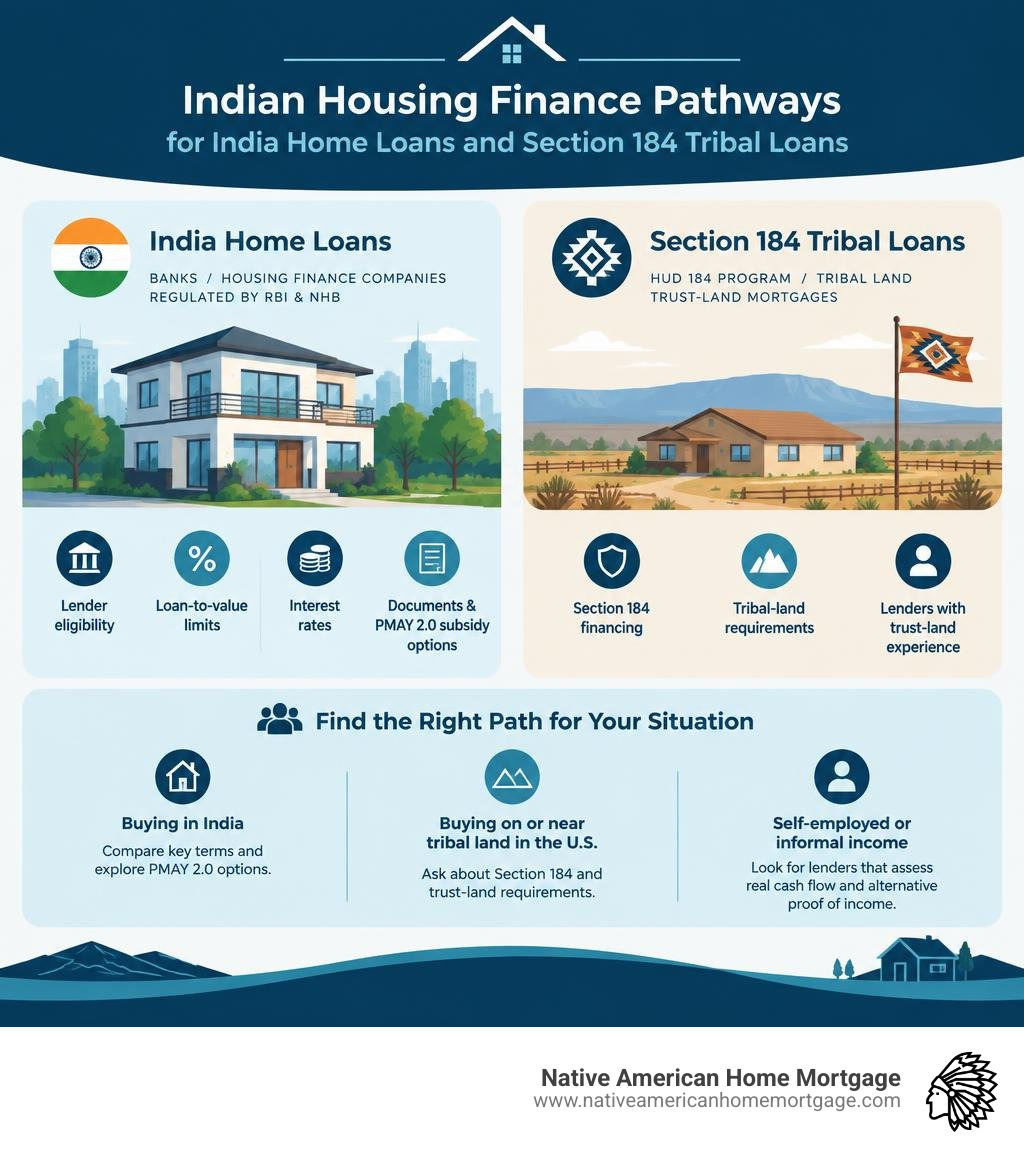
Indian housing finance can mean two very different systems. In India, it refers to regulated home lending through banks and housing finance companies, shaped by the Reserve Bank of India and the National Housing Bank. In the United States, “Indian housing finance” may refer to Native American homeownership programs, including the HUD Section 184 Indian Home Loan Guarantee Program.
Before applying, identify the system that fits your home and land:
- Buying in India: Compare lender eligibility, loan-to-value limits, interest rates, documents, and PMAY 2.0 subsidy options.
- Buying on or near tribal land in the U.S.: Ask about Section 184 financing, tribal-land requirements, and lenders experienced with trust-land mortgages.
- Self-employed or informal income: Look for lenders that assess real cash flow and alternative proof of income, not only pay stubs or tax returns.
The rules matter because a standard mortgage may not work for every borrower, especially when tribal land status, nontraditional income, or government-backed guarantees affect underwriting.
I’m Dale Gremillion, a Senior Loan Officer and Producing Branch Manager with more than 25 years in residential lending, including Conventional, FHA, VA, USDA, and HUD 184 loans. My work in Indian housing finance focuses on helping Native American borrowers understand options that conventional lenders may overlook.
Learn more about indian housing finance:
- Home Loan Eligibility Calculator
- Housing Loan Companies in India
- Housing Loan Schemes in India
Understanding the Indian Housing Finance Regulatory Architecture
Securing a mortgage requires navigating statutory guidelines designed to balance lender security with consumer access. When borrowers evaluate a practical guide to home financing options, they encounter frameworks built to channel credit into underserved demographics while keeping systemic default rates low.
In India’s financial sector, housing finance companies (HFCs) operate under the primary regulatory oversight of the Reserve Bank of India (RBI), with development, promotional, and liquidity backing coordinated by the National Housing Bank (NHB). These entities qualify for Priority Sector Lending (PSL) mandates, which incentivize institutions to allocate substantial capital pools to affordable and lower-income housing projects.
To protect systemic solvency, regulatory frameworks mandate strict risk management standards. HFCs implement comprehensive forensic audits to prevent loan-level fraud, establish robust term deposit governance, and enforce next-generation cybersecurity protocols such as enterprise firewalls and vulnerability assessments.
National Housing Bank Mandate and Market Stability
The National Housing Bank traces its lineage to the Seventh Five Year Plan (1985–90), which identified a critical absence of structured, long-term household debt mechanisms. Established pursuant to the National Housing Bank Act of 1987, the NHB serves as an apex institution designed to promote regional housing credit institutions and supply secondary market liquidity.
Beyond funding support, the NHB tracks national urban property valuation dynamics through its RESIDEX index. It also spearheads green housing initiatives that encourage developers and borrowers to adopt energy-efficient, climate-resilient construction practices alongside subsidized credit facilities like PMAY 2.0.
Distinguishing Domestic Housing Credit from Federal Tribal Guarantee Programs
Because terminology can overlap, borrowers must distinguish domestic mortgage credit in South Asia from American Indian tribal housing initiatives in the United States. In the U.S., federal initiatives like the Section 184 Indian Housing Loan Guarantee Program address unique jurisdictional challenges on tribal trust lands.
Administered by the Department of Housing and Urban Development (HUD) through its Office of Native American Programs (ONAP), Section 184 Indian housing loans deliver a 100% federal guarantee to private lenders. This guarantee eliminates private mortgage insurance (PMI) and lowers down-payment barriers for enrolled members of federally recognized tribes, whether purchasing on or off reservations.
| Structural Feature | Indian Domestic Housing Finance (RBI/NHB) | U.S. Tribal Housing Finance (HUD Section 184) |
|---|---|---|
| Primary Regulator / Administrator | Reserve Bank of India / National Housing Bank | U.S. Dept. of Housing & Urban Development (HUD) |
| Target Demographic | Salaried, self-employed, EWS, LIG, and MIG buyers | Enrolled members of federally recognized Native tribes |
| Land / Property Jurisdiction | Fee-simple freehold, leasehold, Gram Panchayat lands | Fee-simple, individual trust, and tribal trust land |
| Government Guarantee Level | Interest subsidies (e.g., PMAY), no direct lender guarantee | 100% federal loan guarantee to participating lenders |
| Down Payment / LTV Rules | 10% to 25% down (LTV capped at 75%–90%) | 1.25% down (<$50k) or 2.25% down (LTV up to 97.75%) |
| Mortgage Insurance Burden | Optional property/life insurance bundle | No monthly private mortgage insurance (PMI) |
Credit Guidelines, Eligibility, and Underwriting Standards

Mortgage underwriting balances risk exposure against repayment capacity. Whether evaluating credit in urban domestic centers or under specialized tribal lending authorities, underwriting relies on precise loan-to-value (LTV) limits, verified monthly income, debt-to-income (DTI) thresholds, and clear title documentation.
In standard domestic frameworks, maximum loan tenures range between 20 and 32 years, with typical financing covering up to 90% of property market value for smaller ticket sizes and stepping down to 75% for higher-value properties. Processing fees generally span 0.5% to 1.0% of the principal, often establishing a floor such as ₹10,000 plus applicable taxes.
Assessing Eligibility Across Indian Housing Finance Segments
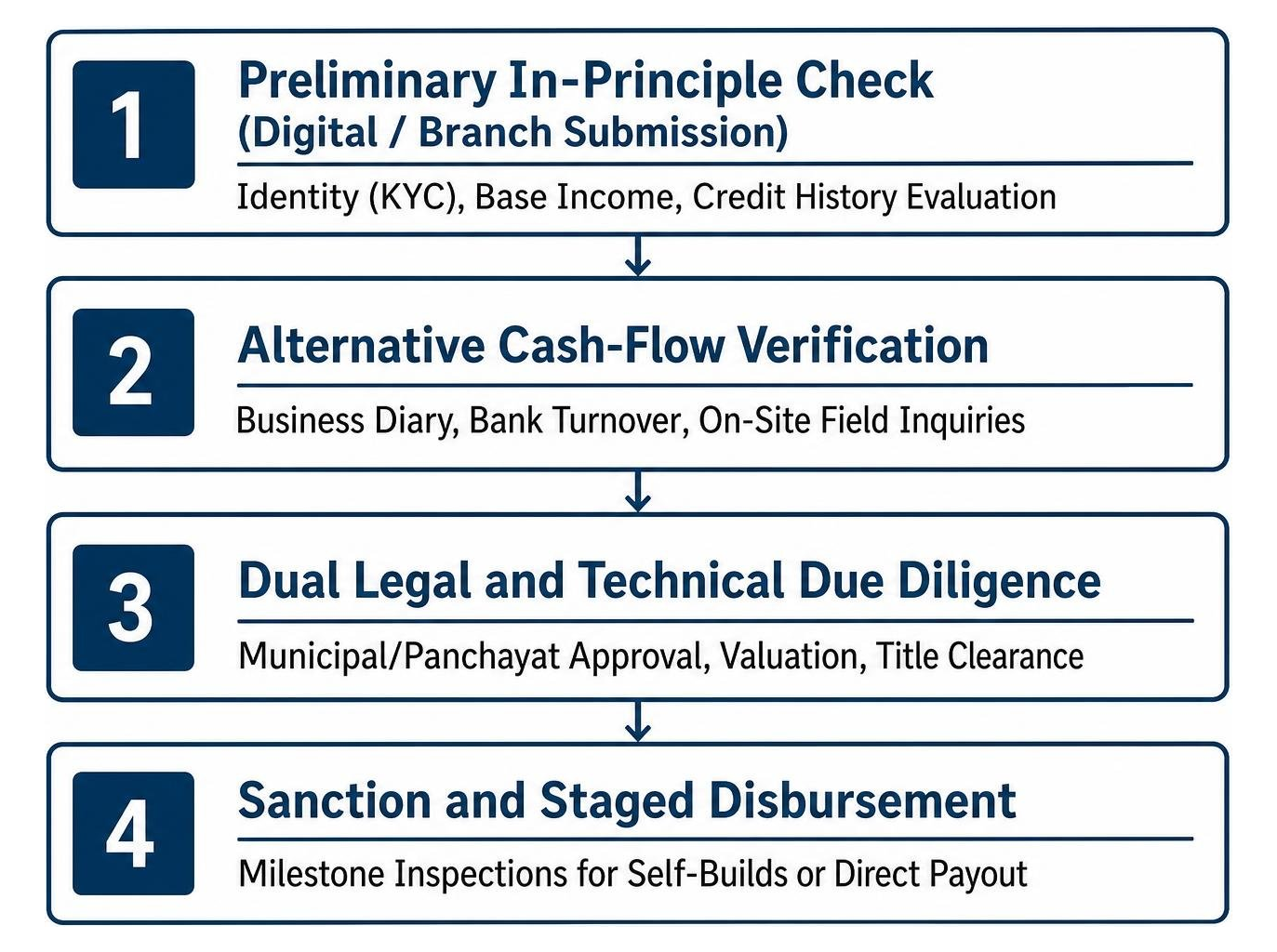
Traditional banking models favor formal salaried workers who produce monthly pay slips, Form 16s, and automated tax filings. However, specialized housing finance providers have adapted their underwriting to serve informal sector workers and micro-entrepreneurs.
For borrowers exploring an Indian bank housing finance complete home loan breakdown, credit assessment teams look beyond standard salary slips. Lenders evaluate surrogate cash-flow metrics, physical inventory levels, customer foot-traffic patterns, and utility payment consistency. By conducting field visits to local market stalls or family workshops, underwriters establish genuine debt-service capacity even when applicants have no formal tax history.
First-Time Homebuyer Support and Statutory Tax Benefits
First-time purchasers receive institutional assistance through statutory tax exemptions and concessionary financing structures. Under Indian domestic tax frameworks, individual borrowers can claim statutory deductions under Section 80C on principal repayments up to statutory ceilings, alongside interest deductions under Section 24(b).
Exploring all about Indian house loan options helps buyers combine these deductions with lower stamp duty concessions for female co-owners, significantly reducing the lifetime cost of homeownership.
Government Subsidy Schemes and Specialized Loan Structures

Public programs provide targeted interest subventions to make homeownership viable for lower-income households. The Pradhan Mantri Awas Yojana (PMAY) mission, including its updated PMAY-U 2.0 guidelines, serves Economically Weaker Sections (EWS), Low Income Groups (LIG), and Middle Income Groups (MIG). These initiatives offer upfront interest subsidies that credit directly to the borrower’s loan account, reducing total monthly payments.
Specialized Credit: Balance Transfers, Top-Up Loans, and LAP
Beyond standard purchase financing, housing finance frameworks support ongoing capital management:
- Home Loan Balance Transfers: Borrowers refinance an existing high-interest balance with an alternative lender offering lower interest margins, reducing total repayment expense.
- Top-Up Loans: Homeowners secure additional funds atop their existing mortgage at rates far lower than unsecured personal debt, using proceeds for home repairs or extensions.
- Loan Against Property (LAP): Borrowers pledge unencumbered residential or commercial real estate to unlock long-term liquidity for business expansion or debt consolidation.
Native Community Lending and Tribal Land Programs
In the United States, lending on tribal reservations requires specialized structures because tribal trust lands cannot be encumbered with private liens or alienated. Programs supporting economic growth in Indian Country through Native loans and grants bridge this divide by substituting conventional foreclosure remedies with federal guarantees and tribal leasehold agreements.
Tribal members seeking to secure Native American housing grants this year can combine local Down Payment Assistance (DPA) with Section 184 mortgages. This hybrid approach enables borrowers to construct, purchase, or rehabilitate homes on sovereign land without risking land alienation.
Digital Transformation in Loan Origination and Processing
Modern fintech platforms have compressed loan origination timelines from several weeks down to a matter of days. Automated document validation engines, Aadhaar-based e-KYC, account aggregators, and digital property evaluation tools allow lenders to evaluate credit risk almost instantly.
Qualified borrowers can now obtain preliminary in-principle sanction letters within 10 to 15 minutes. This digital speed equips buyers to negotiate property purchases with firm financing already in hand.
Key Milestones in Indian Housing Finance Approvals
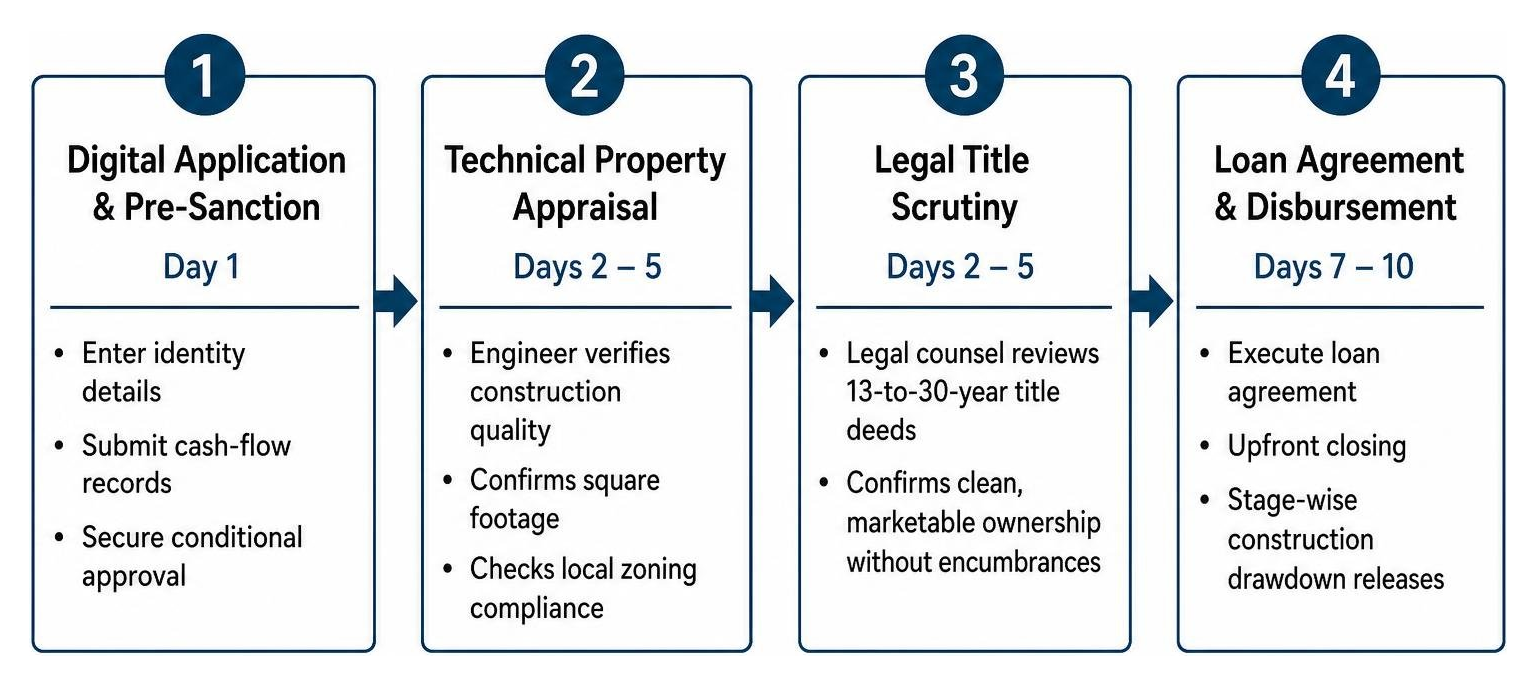
Completing a loan requires four distinct steps:
- Digital Application and Pre-Sanction: The borrower enters identity details, submits cash-flow records, and secures conditional approval.
- Technical Property Appraisal: An authorized engineer verifies physical construction quality, square footage, and local zoning compliance.
- Legal Title Scrutiny: Legal counsel reviews 13-to-30-year title deeds to confirm the seller holds clean, marketable ownership without encumbrances.
- Disbursement: The lender releases loan proceeds in a single lump-sum payout for completed purchases, or via staged tranches tied to construction milestones for self-build properties.
Frequently Asked Questions About Housing Finance
How do regulatory guidelines protect borrowers under housing finance frameworks?
Regulatory frameworks establish transparency mandates that protect retail borrowers:
- Benchmark Lending Rates: Lenders must tie floating-rate loans to external, transparent benchmarks to ensure fair interest-rate adjustments.
- Zero Prepayment Penalties: Regulators prohibit exit fees on floating-rate individual home loans, allowing borrowers to refinance or pay down balances early without penalty.
- Transparent Fee Schedules: Lenders must disclose all administrative, legal, and processing costs upfront, preventing unexpected charges at closing.
Can self-employed individuals secure housing finance without standard tax returns?
Yes. Specialized housing finance companies regularly approve loans for self-employed individuals without formal income tax returns (ITR). Underwriters evaluate alternative income through:
- Surrogate Banking Metrics: Calculating average daily balances and recurring deposits.
- Cash-Flow & Ledger Analysis: Reviewing supplier payment slips, customer purchase logs, and physical stock.
- Direct Business Verification: Conducting in-person site visits to inspect commercial premises, customer volume, and operational equipment.
What distinguishes tribal trust land financing from standard fee-simple mortgages?
Tribal trust lands are held in trust by the federal government for the benefit of a sovereign Native nation. Individual parcels cannot be sold, encumbered, or foreclosed upon by commercial banks under state court jurisdictions.
Financing on trust land relies on long-term residential leases approved by both the Tribe and the Bureau of Indian Affairs (BIA). Under programs like HUD Section 184, if a borrower defaults, the federal guarantee protects the lender from loss, while the underlying land lease remains preserved within the tribe’s jurisdiction.
Conclusion
Securing the right home loan requires matching your specific land tenure, employment structure, and income profile with the appropriate lending framework. Whether navigating domestic housing finance guidelines or seeking a specialized tribal trust land mortgage, selecting the right program prevents unexpected delays and secures sustainable, long-term financing.
If you are an enrolled tribal member looking to purchase, build, or refinance on or off tribal lands, our team at Native American Home Mortgage provides dedicated guidance through the HUD Section 184 program overview. Explore your options and secure the ideal financing path for your dream home today.