How to Finance a Property in India
The right loan depends on what you plan to buy or build. In India, a home loan can finance a completed house, while a plot loan covers land and a composite loan can cover both land and construction. Start by checking your income, existing debts, credit history, and the property’s documents. Then compare lenders on the interest rate, down payment, fees, and total repayment cost, not just the monthly EMI.
This guide follows the path from choosing a loan to getting the keys. It also explains options for borrowers who already own a home and want to renovate or transfer a loan.
I’m Dale Gremillion, a U.S. mortgage loan officer with over 25 years of experience helping people compare home financing options, including HUD 184 loans for Native American borrowers across states such as Arizona, New Mexico, Oklahoma, and many others where our company operates. Many of our readers have family ties to India or are weighing financing decisions in both countries, so understanding local underwriting standards, benchmark rates, and regulatory protections in India is useful context alongside the U.S. lending programs we specialize in. I bring that lending perspective to a guide grounded in Indian loan terms, without claiming to originate loans in India.

Helpful financing topics:
- home loan eligibility calculator
- indian house loan
- housing loan schemes in india
Understanding the Landscape of Real Estate Loan India Financing
India’s property market continues to expand rapidly. Backed by solid economic fundamentals, the nation’s real GDP grew by 8.2% in FY24, with fiscal forecasts consistently projecting robust long-term expansion. Rapid urbanization is a major driving force: the urban population is expected to reach 37.4% of the total population, while the overall number of households is projected to reach approximately 385 million by 2031.
Aspirational households—those earning between ₹0.2 million and ₹1 million annually—are expanding from 41 million in FY12 to an estimated 181 million by FY30. As per capita net national income expanded by 6.7% in fiscal 2024, the demand for formal housing credit has surged. Comprehensive industry reporting on the Finance Market in India shows how retail mortgages serve as the primary engine for middle-class wealth creation. Financial inclusion programs like PMJDY, which reached over 0.52 billion accounts with deposits exceeding ₹2,299 billion, have brought millions of new borrowers into the formal banking sector. Whether you are exploring all about Indian house loan options or reviewing the best housing loan companies in India ranked, understanding how Indian mortgage structures operate is essential before signing any paperwork.
Structural Features of a Real Estate Loan India Framework
A real estate loan in India operates as a secured credit instrument. The underlying residential or commercial property serves as primary collateral through an equitable or registered mortgage. Under Reserve Bank of India (RBI) guidelines, retail lending rates are tied directly to an external benchmark—most commonly the RBI Policy Repo Rate.
When the central bank adjusts monetary policy, floating-rate mortgages reflect those shifts through the Repo-Linked Lending Rate (RLLR). Standard terms also include:
- Mandatory registration with the Central Registry of Securitisation Asset Reconstruction and Security Interest (CERSAI) to prevent fraudulent multi-lender pledging on a single property.
- Clear guidelines barring foreclosure charges on individual floating-rate loans.
- Standard underwriting based on verifiable cash flows rather than unverified asset valuations alone.
Fixed vs. Floating Interest Rate Dynamics
Borrowers must decide between fixed-rate and floating-rate loans. A fixed interest rate keeps the borrowing cost constant for an agreed period, providing predictable monthly budgeting regardless of macroeconomic fluctuations. However, fixed rates typically carry a premium of 100 to 250 basis points above prevailing floating rates and may include prepayment penalties for early closure.
Floating-rate loans fluctuate directly with monetary policy cycles. In an easing interest rate environment, your EMI or effective tenure decreases automatically. Most importantly, the RBI prohibits lenders from charging prepayment or foreclosure penalties on floating-rate housing loans given to individual borrowers.
| Feature | Fixed Interest Rate | Floating Interest Rate |
|---|---|---|
| Rate Stability | Constant across the fixed term | Fluctuates with RBI Repo Rate changes |
| Initial Pricing | Typically higher (1% to 2.5% premium) | Lower base rate benchmarked to repo rate |
| Prepayment Penalties | Applicable in many conventional structures | Zero penalty for individual borrowers (RBI mandate) |
| Best Suited For | Bottom of rate cycle; strict fixed-budget borrowers | Long-term borrowers wanting prepayment flexibility |
Core Categories: From Plot Acquisition to Home Construction
Not all property transactions involve ready-to-move apartments. Indian lending institutions offer structured loan products matched to specific purchase stages. Exploring a practical guide to home financing options helps pinpoint which product fits your scenario:
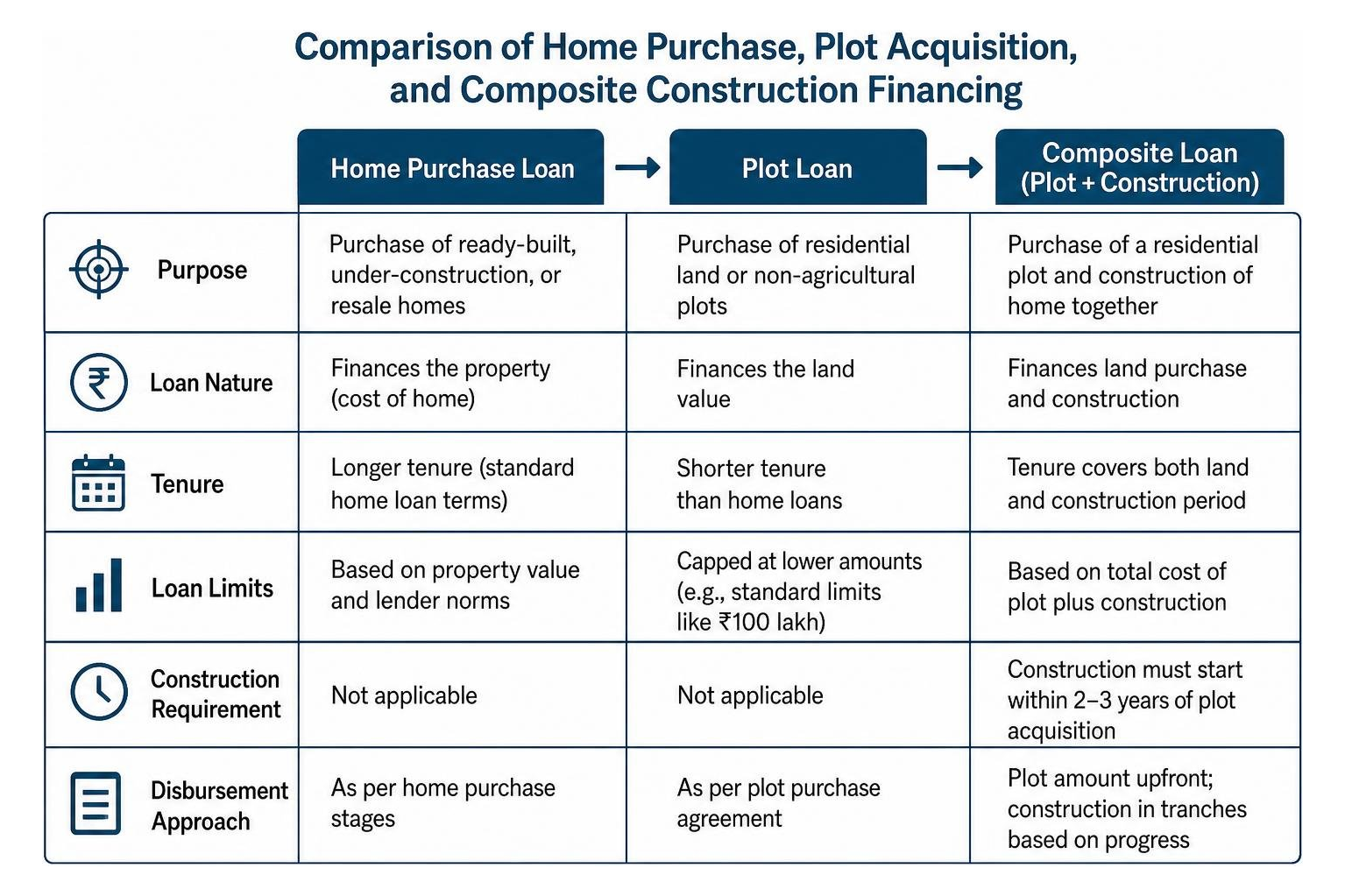
- Standard Home Purchase Loans: Used for ready-built apartments, developer under-construction units, or resale homes.
- Plot Loans: Designed specifically for purchasing direct residential land or non-agricultural plots. Lenders often cap land loans at lower amounts (for example, standard limits like ₹100 lakh) and enforce shorter tenures than regular home loans.
- Composite Loans: Finance both the purchase of a residential plot and the subsequent home construction under a unified sanction, requiring construction to start within a designated timeframe (often within 2 to 3 years of plot acquisition).
- Home Construction Loans: Cover the construction expenses of building on land you already own, disbursed in tranches matched to physical engineering milestones.
- Home Extension and Renovation Loans: Fund structural additions, interior works, or substantial civil repairs, often capped at set percentages of property value.
Specialized Financing Products: Overdraft, Flexipay, and Top-Up Options
Modern Indian banking provides flexible mortgage products tailored to varied cash flow patterns:
- Home Loan Overdraft Facilities: Lenders connect your mortgage account to an operational current or savings account. Any surplus funds deposited into this linked account directly offset the outstanding principal balance used for daily interest calculations. You retain complete liquidity to withdraw surplus funds whenever needed while reducing your total interest liability.
- Step-Up / Flexipay Repayment: Designed for young professionals with growing career trajectories, this model allows borrowers to pay lower EMIs (or interest-only payments) during the initial 3 to 5 years, stepping up to standard amortizing EMIs as their earnings increase.
- Pre-Qualified Top-Up Facilities: Existing home loan borrowers with a clean repayment track record can secure additional mortgage-linked funds (often up to ₹1 crore) at interest rates only 1% to 2% above their baseline mortgage rate, avoiding expensive personal loans.
Niche Programs for Government Employees, Defense, and NRIs
Lenders design specialized underwriting tracks for specific demographic groups. Public sector employees and defense personnel frequently receive concessions on processing fees and interest rate discounts under specialized government and defense housing programs. Reviewing the top housing loan schemes in India reveals dedicated options for armed forces veterans, state and central government staff, and women primary applicants who receive interest concessions of around 0.05% (5 basis points).
Non-Resident Indians (NRIs) and Persons of Indian Origin (PIOs) can purchase residential property in India through dedicated NRI mortgage pathways. These loans require documentation of overseas employment, valid visa/work permits, salary credit through NRE/NRO accounts, and the appointment of a local Power of Attorney (PoA) in India to execute physical mortgage deeds.
Eligibility Criteria, LTV Caps, and Mandatory Documentation

Qualifying for a property loan requires satisfying both personal credit parameters and property-level legal checks. Lenders assess:
- Age Limits: Minimum entry age is typically 18 to 21 years, with loan maturity capped between age 60 and 70 (or up to 75 years for select self-employed borrowers or pension-backed schemes).
- Credit Score: A CIBIL score of 725 or above is the baseline standard for competitive pricing. Borrowers with scores above 750 to 800 qualify for the lowest available risk spreads.
- Fixed Obligation to Income Ratio (FOIR): Lenders typically restrict total monthly debt payments (including the proposed home loan EMI) to 40%–50% of net monthly income for moderate earners, expanding up to 60%–65% for high-income applicants.
- Loan Quantum: Quantum limits range from ₹2 Lakh to ₹10–15 Crore across major financial institutions, with public sector banks providing need-based sanctions up to 72 to 96 times the applicant’s monthly gross income.
Loan-to-Value (LTV) Ratios and Borrower Contribution
The RBI mandates strict Loan-to-Value (LTV) limits to preserve systemic banking stability. Lenders cannot finance 100% of the property purchase price; borrowers must contribute equity (own contribution) based on the loan size:
- Loans up to ₹30 Lakh: Maximum LTV up to 90% (Minimum borrower down payment: 10%).
- Loans between ₹30 Lakh and ₹75 Lakh: Maximum LTV up to 80% (Minimum borrower down payment: 20%).
- Loans above ₹75 Lakh: Maximum LTV up to 75% (Minimum borrower down payment: 25%).
Note: Statutory charges like stamp duty, registration fees, and municipal property taxes cannot be included in the property cost when calculating LTV limits.
Comprehensive Documentation for Salaried, Self-Employed, and Non-Resident Borrowers
A smooth underwriting experience requires a clear set of documents:
Reviewing an Indian bank housing finance complete breakdown or checking prevailing home loan interest rates will help you align these documents with specific institutional requirements.
Interest Rates, EMI Dynamics, and Tax Maximization Strategies
Indian home loans calculate interest on a daily reducing balance method. In this setup, your monthly installment reduces the principal balance immediately, ensuring interest applies only to the remaining unpaid debt each day.
Standard home loan tenures range up to 30 years (with select housing finance companies offering up to 32 years). Extending your tenure reduces your monthly EMI, making qualification easier, but substantially increases total interest paid over the life of the loan.
| Loan Amount | Tenure | Assumed Interest Rate | Monthly EMI | Total Interest Payable | Total Repayment Cost |
|---|---|---|---|---|---|
| ₹50,00,000 | 10 Years | 8.50% | ₹61,992 | ₹24,39,079 | ₹74,39,079 |
| ₹50,00,000 | 20 Years | 8.50% | ₹43,391 | ₹54,13,879 | ₹1,04,13,879 |
| ₹50,00,000 | 30 Years | 8.50% | ₹38,446 | ₹88,40,490 | ₹1,38,40,490 |
As the table illustrates, extending the term from 10 to 30 years lowers the monthly payment by ₹23,546, but more than triples the total interest paid.
Additional upfront fees must also be factored in:
- Processing Fees: Typically 0.25% to 0.50% of the loan amount (often capped between ₹3,000 and ₹15,000 in public banks, or up to 2%–4% at non-bank lenders).
- Administrative / CLADUM Fees: Credit, Legal, Administrative, Documentation, Upkeep, and Maintenance fees covering physical site inspection, legal title clearance, and appraisal.
- Statutory Charges: CERSAI filing fees (nominal ₹50–₹100) and state-specific stamp duty on mortgage deeds (MODTD).
Calculating EMIs for a Real Estate Loan in India
Monthly EMI calculations follow the standard amortizing loan formula:
EMI = [P × R × (1+R)^N] / [(1+R)^N – 1]
- P: Principal loan amount
- R: Monthly interest rate (Annual interest rate divided by 12 months divided by 100)
- N: Loan tenure in total months
In the early years of repayment, up to 70% to 80% of your EMI goes toward interest. Over time, the interest share declines while the principal portion increases. Borrowers can use digital tools like a home loan eligibility calculator to run prepayment scenarios. Making small, regular principal prepayments each year directly targets the loan balance and can shave years off your repayment timeline.
Tax Deduction Maximization Under Sections 80C, 24(b), and 80EEA
The Indian Income Tax Act provides significant tax deductions for residential mortgage borrowers under the Old Tax Regime:
- Section 24(b) – Interest Deduction: Deduct up to ₹2,00,000 annually against interest paid on a loan for a self-occupied property. For let-out properties, the entire interest can be deducted, subject to overall loss adjustment caps under house property rules.
- Section 80C – Principal Repayment: Claim deductions up to ₹1,50,000 annually for principal repayments, including stamp duty and registration expenses paid during the year of purchase (within the overall ₹1.5 lakh Section 80C umbrella).
- Co-Borrower Maximization: When a husband and wife (or parent and child) co-own the property and co-sign the mortgage, both can claim individual deductions. Together, a couple can claim up to ₹4,00,000 in interest deductions under Section 24(b) and up to ₹3,00,000 in principal deductions under Section 80C each financial year.
Step-by-Step Application Process and Balance Transfers
Securing a mortgage follows a clear sequence from application to disbursement:
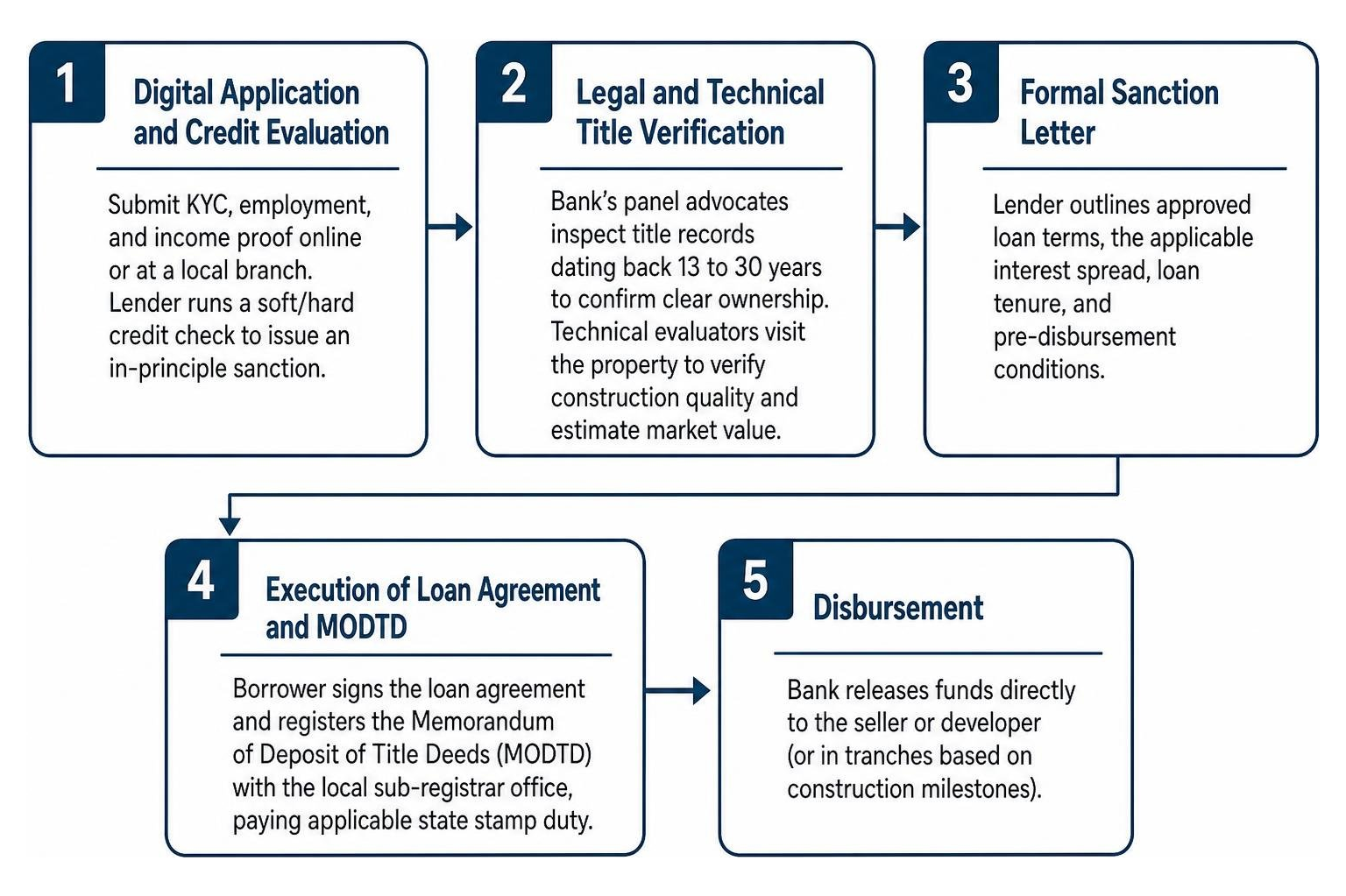
- Digital Application and Credit Evaluation: Submit your KYC, employment, and income proof online or at a local branch. The lender runs a soft/hard credit check to issue an in-principle sanction.
- Legal and Technical Title Verification: The bank’s panel advocates inspect title records dating back 13 to 30 years to confirm clear ownership. Independent technical evaluators visit the property to verify construction quality and estimate market value.
- Formal Sanction Letter: The lender outlines approved loan terms, the applicable interest spread, loan tenure, and pre-disbursement conditions.
- Execution of Loan Agreement and MODTD: The borrower signs the loan contract and registers the Memorandum of Deposit of Title Deeds (MODTD) with the local sub-registrar office, paying applicable state stamp duty.
- Disbursement: The bank releases funds directly to the seller or developer (or in tranches based on construction milestones).
How to Execute a Home Loan Balance Transfer
A Home Loan Balance Transfer (refinancing) lets you move your outstanding mortgage balance from your current lender to a new institution offering a lower interest rate or better terms.
To evaluate whether a balance transfer makes financial sense:
- Calculate the Interest Differential: A rate drop of 25 to 50 basis points (0.25% to 0.50%) on a long-term loan can yield significant savings over 15 to 25 years.
- Account for Switching Costs: Tally all processing fees, valuation costs, legal scrutiny charges, and state mortgage stamp duties required by the new lender.
- Obtain Foreclosure Documents: Request a List of Documents (LOD) and an official Foreclosure Letter stating the exact outstanding balance from your existing lender.
- Disbursement and Title Release: The new bank issues a payout cheque directly to the current lender. Once settled, the original bank releases the property title deeds to the new institution within 15 to 30 days.
Critical Application Mistakes to Avoid
- Making Multiple Simultaneous Loan Inquiries: Applying to several lenders at once triggers multiple hard credit checks, which can temporarily lower your CIBIL score.
- Overlooking Unapproved Structural Alterations: Purchasing a home with unauthorized modifications or missing local authority approvals can halt loan disbursement during technical appraisal.
- Concealing Short-Term Debts: Omitting existing personal loans, credit card balances, or Buy-Now-Pay-Later (BNPL) accounts can lead to instant underwriting rejections for non-disclosure.
- Ignoring Property Title Lineage: Always demand a complete encumbrance certificate (EC) for at least 13 to 30 years to confirm the seller holds clean, unencumbered title.
Frequently Asked Questions About Real Estate Loans
What is the standard CIBIL score required for approval?
Most Indian lenders look for a minimum CIBIL score of 725. A score above 750 or 800 helps you secure the lender’s lowest interest rate tier with minimal risk markups. While borrowers with scores between 650 and 720 can still qualify, they usually face higher interest rates and stricter documentation.
Can I obtain 100% financing for property purchases in India?
No. RBI regulations strictly prohibit banks and housing finance companies from providing 100% funding for real estate acquisitions. Borrowers must make a mandatory down payment of 10% to 25% of the property value, depending on the loan size. Ancillary expenses like stamp duty and registration must also be funded out-of-pocket.
How does a composite loan differ from a regular home loan?
A regular home loan finances a ready-built property, an under-construction flat, or home renovation. A composite loan provides dual-stage financing: one tranche to purchase a residential plot, followed by subsequent construction tranches to build the home. Lenders typically require home construction to begin within 2 to 3 years of acquiring the land.
Conclusion
Securing property financing in India requires a balanced approach that looks beyond just the lowest headline interest rate. By assessing your loan eligibility, budgeting for mandatory down payments and statutory fees, choosing between fixed and floating rates, and verifying all property title documents, you can finance your purchase with confidence.
Smart financial planning—such as taking advantage of joint tax deductions under Section 24(b) and Section 80C, or using an overdraft-style mortgage—can save you lakhs of rupees in interest over the life of your loan. These same principles of comparing total repayment cost, understanding down payment requirements, and verifying documentation also apply to borrowers in the United States exploring HUD 184 financing in their home state. If you are weighing property financing decisions here in the U.S., including the HUD 184 loan programs we offer across states like Alabama, California, Oklahoma, Washington, and many others, exploring structured lending solutions through Native American Home Mortgage provides the clarity and resources you need to make well-informed real estate financing decisions.