Understanding the 203k Loan for Earthquake Retrofit Projects
Navigating major structural repairs can feel overwhelming, especially when managing older properties situated near active fault lines. That is where government-insured financing bridges the gap. The HUD 203(k) Rehabilitation Mortgage Insurance Program enables homeowners and buyers to roll both the purchase (or refinance) balance and the total cost of renovations into a single, manageable primary residence mortgage.
Rather than taking out high-interest personal loans, running up credit cards, or draining personal savings to stabilize an aging foundation, borrowers can finance the upgrades upfront. The loan is underwritten based on the property’s projected After-Repair Value (ARV)—the estimated market value of the home once all seismic retrofitting and remodeling work is completed. For those navigating the 203k loan process for home rehabilitation, this structure unlocks crucial capital to address critical safety issues before disaster strikes.
Choosing Between Standard vs. Limited 203k Loan for Earthquake Retrofit
When structuring a 203k loan for earthquake retrofit work, you must select between two distinct program types based on project complexity and cost:
- The Limited 203k (formerly Streamline): Geared toward minor cosmetic repairs and non-structural upgrades capped at $35,000 in total repair costs. While straightforward foundation bolting that does not alter the fundamental structural framework might slip under this threshold in low-cost scenarios, the Limited program strictly excludes major load-bearing alterations.
- The Standard 203k: Designed specifically for structural modifications, complex engineering tasks, foundation rebuilding, and projects exceeding the $35,000 limit. If your seismic retrofit involves replacing cripple walls, underpinning failed footings, installing structural steel moment frames, or reinforcing soft-story garages, the Standard 203k is required. It mandates a contingency reserve (typically 10% to 20% of repair costs) to absorb unexpected crawl space framing surprises and disburses funds through structured escrow draw inspections.
To clarify which path fits your specific project scope, review the official HUD 203(k) Rehabilitation Mortgage Insurance Program Types guidelines alongside the comparison below:
| Program Feature | Limited 203(k) | Standard 203(k) |
|---|---|---|
| Maximum Repair Budget | Up to $35,000 | Up to local FHA loan limits |
| Structural Alterations | Not allowed (non-structural only) | Allowed (foundation, framing, shear walls) |
| HUD Consultant Required? | Optional (rarely required) | Mandatory |
| Contingency Reserve | Optional (0% to 10%) | Mandatory (10% to 20%) |
| Payout Structure | Two payments (50% start / 50% finish) | Up to 5 staged escrow draw disbursements |
| Best Suited For | Basic anchor bolting (non-structural) | Cripple wall bracing, soft-story retrofits, full foundation repairs |
Role of the HUD-Certified 203k Consultant and Structural Engineers
For a Standard 203k loan, HUD mandates the involvement of an independent expert selected from the official FHA 203(k) consultant roster. Your HUD consultant acts as your project manager, protecting both you and the lender from shoddy workmanship, cost overruns, and code non-compliance.
The consultant conducts an on-site property inspection, generates a formal Feasibility Study, develops detailed architectural exhibits, and prepares a line-item Work Write-Up with precise cost estimates. Because seismic retrofits involve complex load paths and local seismic codes, the consultant collaborates closely with licensed structural engineers. Once construction begins, the consultant inspects the completed work at each milestone before authorizing escrow draw disbursements to your contractor.
Eligible Seismic Retrofitting Measures and Structural Requirements
Much of our nation’s housing inventory located in seismically active regions was constructed before modern building codes were established. Homes built prior to 1935—and many constructed up until the late 1970s—suffer from distinct vulnerabilities:
- Unbolted mudsills: The wood frame simply rests on the concrete foundation via gravity, allowing the home to slide off its perimeter during ground shaking.
- Unbraced cripple walls: Short wood-framed stud walls running between the concrete foundation and the first floor lack shear strength and can collapse like a deck of cards.
- Soft-story configurations: Living areas situated directly above large, unreinforced openings (such as multi-car garages) lack lateral support.
- Post-and-pier foundations: Older homes resting on unreinforced masonry or timber posts without continuous concrete footings can shift or collapse entirely.
Addressing these vulnerabilities requires specific structural interventions tailored to your home’s designated Seismic Design Category.
Structural Upgrades Covered by a 203k Loan for Earthquake Retrofit
Financing via a 203k mortgage covers comprehensive structural upgrades needed to establish a continuous load path from the roof down to the earth:
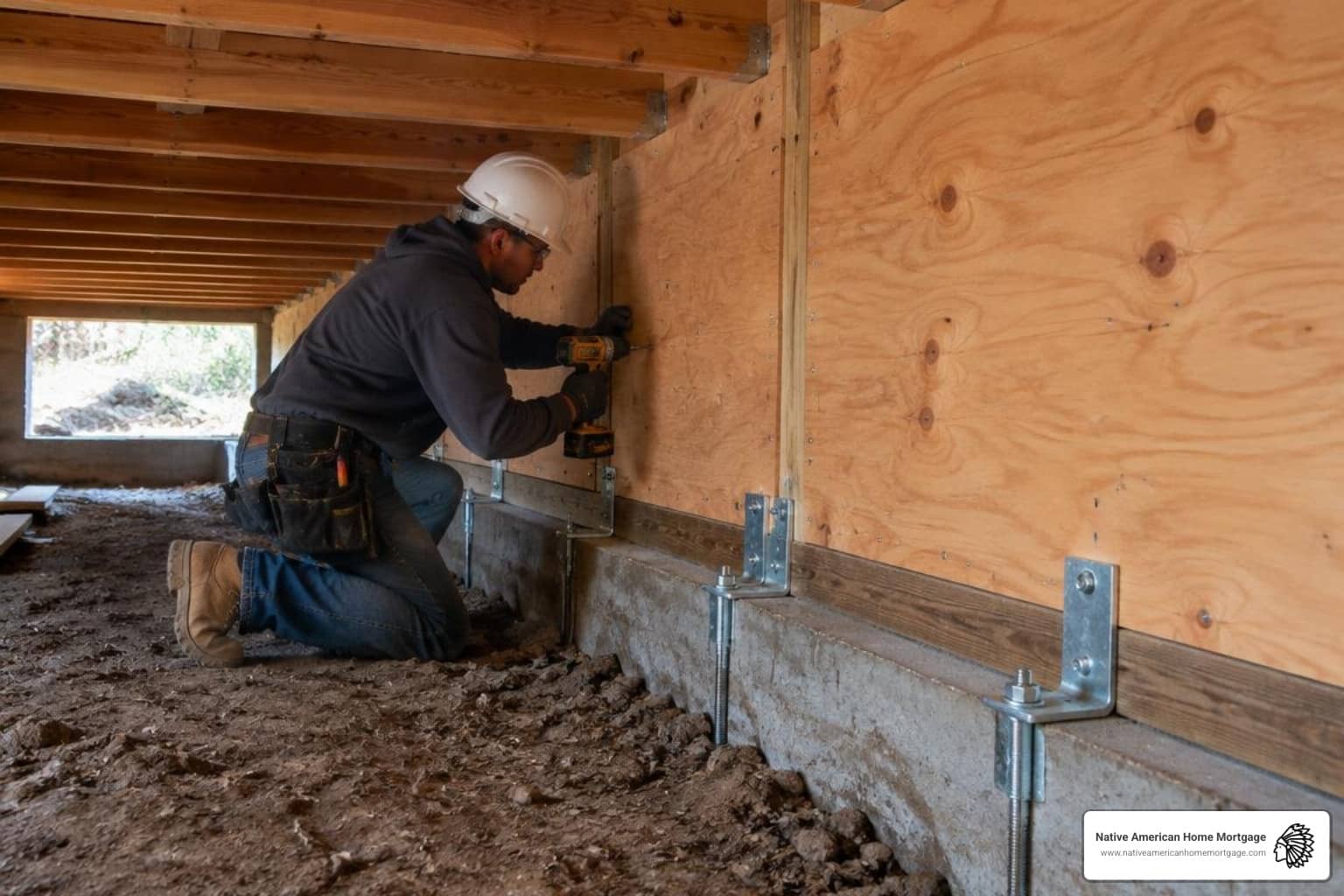
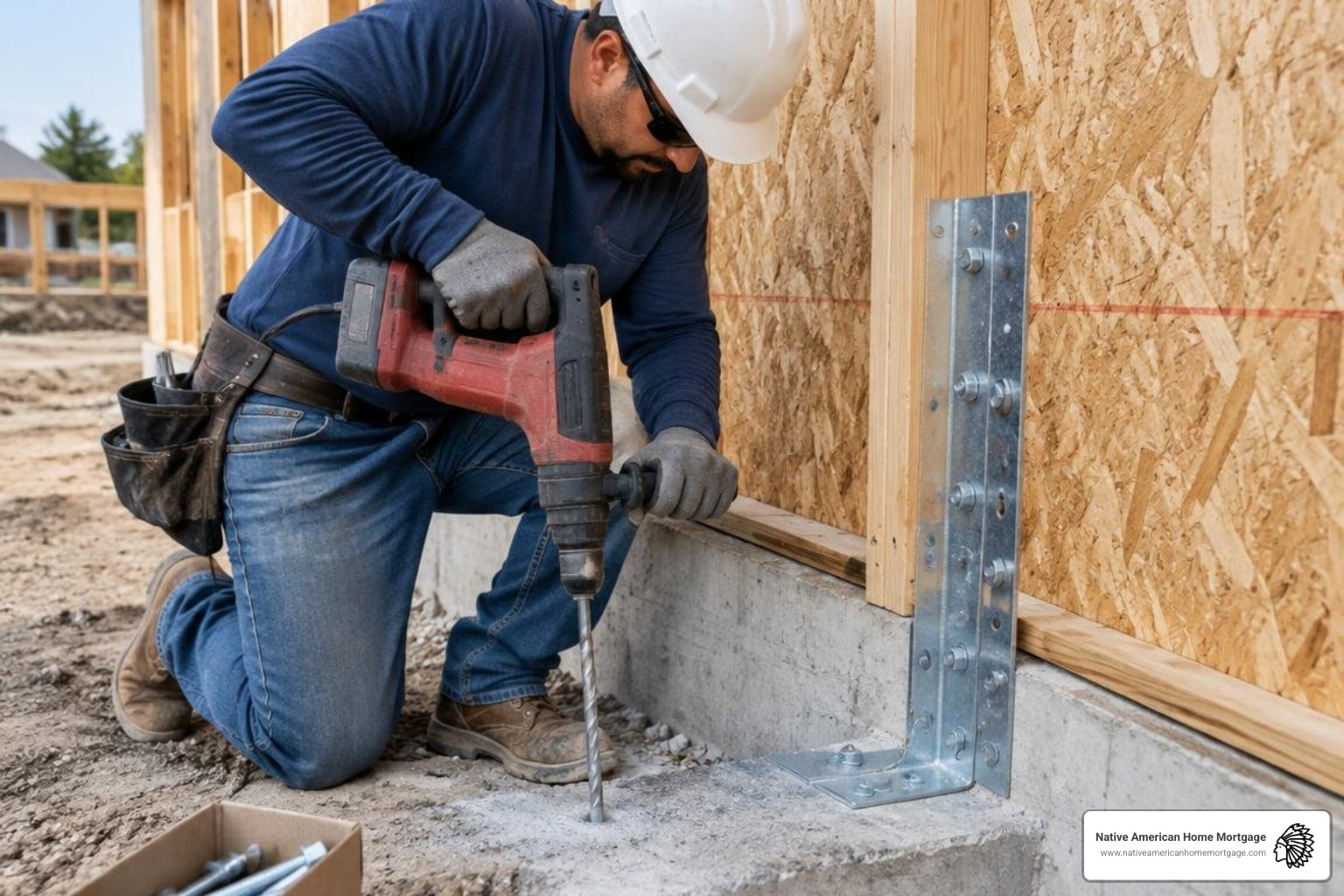
- Foundation Anchor Bolts & Hold-Downs: Drilling into existing concrete footings to install heavy-duty expansion or epoxy anchor bolts and steel hold-down brackets that secure the sill plate directly to the concrete.
- Cripple Wall Sheathing: Nailing 15/32-inch structural plywood or oriented strand board (OSB) to the interior face of cripple wall studs to create rigid shear walls capable of absorbing horizontal ground movement.
- Foundation Repair & Underpinning: Sealing structural cracks, repointing aging mortar beds, or replacing compromised unreinforced masonry with steel-reinforced continuous concrete footings.
- Soft-Story Reinforcement: Installing engineered steel moment frames or prefabricated shear panels around garage door openings to prevent lateral collapse.
- Safety Shutoff Systems: Installing seismic-activated automatic gas shutoff valves to prevent post-earthquake fires caused by severed utility lines.
Homeowners and contractors can utilize standardized engineering guidelines, including prescriptive seismic retrofit plan sets for crawlspace dwellings and the FEMA P-1100-2B retrofit guidelines for living-space-over-garage dwellings, which provide pre-engineered pathways that streamline building department approval.
Meeting FEMA Standards and Local Building Codes
To qualify for 203k financing, all seismic upgrades must comply with municipal building codes and state-specific frameworks, such as the California Existing Building Code (CEBC) Chapter A3. Compliance protects both physical safety and property value.
Furthermore, structural additions must address Performance-Critical Damage thresholds to ensure the dwelling withstands future seismic cycles. If your renovation involves installing prefabricated storm shelters or dual-hazard safe rooms, they must satisfy strict ICC 500-2020 design criteria. Reviewing the FEMA guidelines for post-earthquake repair and retrofit ensures that any preexisting damage is properly classified and remedied rather than merely covered up cosmetically.
Step-by-Step Process: Financing Your Seismic Retrofit with an FHA 203k
Transforming an older, vulnerable property into a seismically sound home using an FHA 203k loan follows a clear, structured sequence:
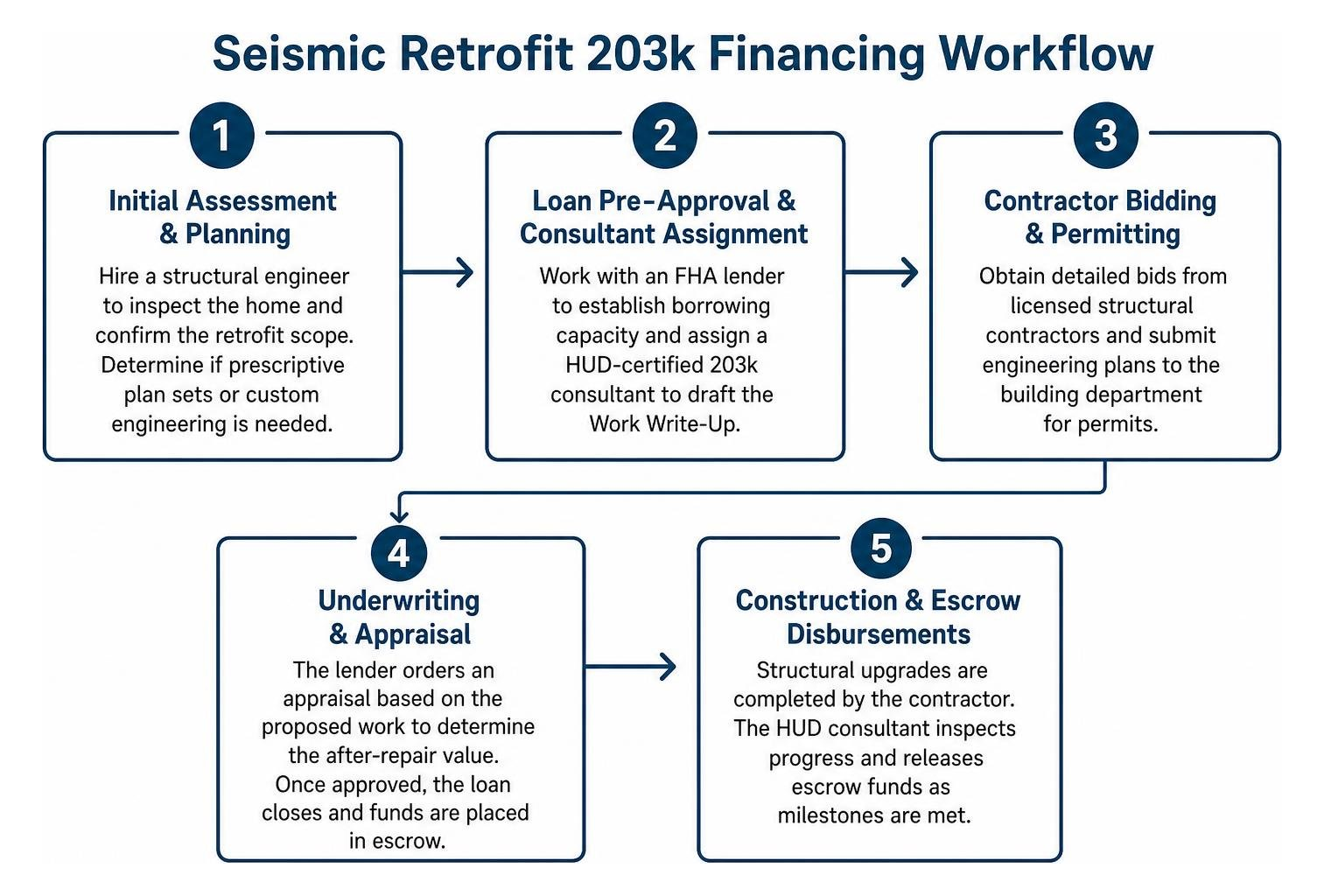
- Initial Assessment & Planning: Hire a licensed structural engineer or seismic specialist to inspect the crawl space, foundation, and framing. Determine whether the project qualifies for prescriptive plan sets or requires custom engineering calculations.
- Loan Pre-Approval & Consultant Assignment: Work with an experienced FHA lender to establish your borrowing capacity and assign a HUD-certified 203k consultant to draft the official Work Write-Up.
- Contractor Bidding & Permitting: Solicit detailed, line-item bids from licensed general or specialty structural contractors experienced in seismic retrofitting. Submit the engineering plans to your local building department for required permits.
- Underwriting & Appraisal: The lender orders an appraisal based on the proposed scope of work to determine the home’s projected after-repair value. Once approved, the loan closes, and renovation funds are deposited into an escrow account.
- Construction & Escrow Disbursements: The contractor completes the foundation bolting, cripple wall sheathing, and structural framing. The HUD consultant performs on-site progress inspections to release escrow draw funds as milestones are met.
- Final Inspection & Title Closeout: The local municipal building inspector conducts a final inspection, signs off on the permit, and the lender completes the final title update and releases the remaining retainage funds.
Getting Pre-Approved and Estimating Retrofit Costs
Qualifying for an FHA 203k loan follows standard FHA guidelines: competitive minimum down payments (as low as 3.5%), flexible credit score requirements (typically 580 or higher), and manageable debt-to-income (DTI) allowances. Reviewing our FHA 203k loan pre-approval requirements and timelines ensures your financial documentation is organized before beginning the application.
Nationally, standard seismic retrofitting for crawl space homes averages between $3,000 and $10,000, with typical foundation bolting projects landing around $5,000. However, complex structural retrofits—such as soft-story garage reinforcement or repairing extensive foundation settlement—can range from $15,000 to over $50,000. Evaluating these costs alongside other options by exploring practical residential financing options helps you build a budget tailored to your family’s long-term financial goals.
Layering 203k Financing with Grants, Rebates, and Insurance Discounts
One of the most powerful strategies for minimizing total out-of-pocket expenses is combining your 203k loan with public mitigation grants and private insurance incentives:
- State Mitigation Grants: The California Residential Mitigation Program offers the Earthquake Brace + Bolt (EBB) grant, providing up to $3,000 toward code-compliant foundation bolting and cripple wall bracing. Income-eligible households (under regional median income caps) may qualify for supplemental grants up to $7,000. Borrowers can consult the Earthquake Brace + Bolt Homeowner Guide and eligibility criteria to verify local ZIP code availability.
- FEMA Hazard Mitigation Assistance: Local municipal and regional mitigation programs occasionally offer matching funds that cover up to 75% of eligible structural strengthening costs.
- Insurance Premium Discounts: After completing your retrofit, submit a Dwelling Retrofit Verification (DRV) form to your insurer. The California Earthquake Authority (CEA) offers discounts between 5% and 25% on annual earthquake insurance premiums for properly braced and bolted homes.
Mitigation investments yield immense financial dividends. Research shows that every dollar spent by FEMA on natural hazard mitigation saves society an average of $4.00 in avoided future losses—with state-level building code improvements showing savings as high as $4.80 per dollar spent with an estimated 10-year payback period. By layering grant funds into your 203k escrow budget, you reduce the required borrowing principal while unlocking permanent recurring insurance savings.

Comprehensive Earthquake Preparedness Beyond Foundation Bolting
While structural retrofitting keeps your home attached to its foundation during severe ground shaking, non-structural hazards inside the living space account for a significant portion of earthquake-related injuries and secondary property damage. A complete earthquake resilience plan addresses both structural and interior safety:
- Water Heater Bracing: Secure your water heater using double heavy-gauge metal strapping bolted directly into wall studs. A ruptured water heater not only presents a severe fire hazard from broken gas lines, but it also destroys a vital 40-to-80 gallon source of clean emergency drinking water.
- Heavy Furniture & Appliance Anchoring: Bolt tall bookcases, china cabinets, armoires, and entertainment centers to wall studs using nylon straps or heavy-duty L-brackets. Ensure wall-mounted flat screens and heavy mirrors are anchored to framing rather than drywall anchors.
- Cabinet Safety Latches: Install childproof or magnetic latches on all upper kitchen and bathroom cabinets. During an earthquake, cabinet doors swing open, hurling heavy glassware, ceramic plates, and toxic chemicals across living areas.
- Utility Shut-Off Protocols: Teach every member of the household how and when to shut off the main water, gas, and electrical disconnects. Keep an adjustable wrench strapped directly to the external gas meter.
- Emergency Kits & Reunification Plans: Assemble a portable disaster survival kit containing non-perishable food, water purification tablets, first-aid supplies, solar/crank emergency radios, heavy work gloves, and backup power banks. Systematically rotate stored food and water every six to twelve months. Establish an out-of-state emergency contact, as long-distance telecommunications networks frequently recover faster than overloaded local cellular infrastructure following a disaster.
Frequently Asked Questions About Seismic Retrofitting with 203k Loans
Can I complete a DIY earthquake retrofit using a 203k loan?
Under the FHA 203k program, do-it-yourself labor is heavily restricted. HUD regulations require all structural work to be performed by licensed, insured, and experienced general or specialty trade contractors. Because seismic retrofits involve structural integrity, anchor bolt torque ratings, and local building permits, lenders will not disburse escrow draw funds to owner-builders for labor. The safety of your home and mortgage backing depends on certified, code-compliant craftsmanship.
How much can I save on earthquake insurance after completing a seismic retrofit?
Completing an engineered seismic retrofit can reduce your annual earthquake insurance premiums significantly. For example, policyholders with the California Earthquake Authority (CEA) can receive discounts ranging from 5% to 25% on their dwelling coverage once a licensed engineer or building inspector signs off on the official Dwelling Retrofit Verification (DRV) form. For a policy costing $2,000 annually, this can save up to $500 per year, quickly paying down your retrofit investment over time.
How does an earthquake retrofit affect the appraised value of my home?
Appraisers evaluating properties in high-risk seismic zones recognize the added marketability and structural durability of a seismically upgraded home. While non-structural cosmetic upgrades sometimes offer faster visual appeal, a documented foundation retrofit protects the home against catastrophic loss, eliminates red-tagging risks from building officials, and broadens your pool of qualified buyers when you decide to sell. Under the 203k program, your loan amount is backed directly by this improved After-Repair Value (ARV).
Conclusion
Securing older residential properties against seismic hazards is one of the most impactful investments a homeowner can make. By leveraging an FHA 203k loan for earthquake retrofit projects, you can finance vital foundation bolting, cripple wall sheathing, and soft-story reinforcement directly into a single, low-interest mortgage. Combined with state mitigation grants and insurance premium discounts, modern hazard mitigation delivers proven safety and substantial long-term equity protection.
At Native American Home Mortgage, we are dedicated to helping families build safe, enduring homes backed by resilient structural foundations. Whether you are purchasing an older home in an active fault zone or refinancing your existing property to complete needed structural repairs, our team is here to guide you every step of the way. Take the next step toward securing your home by mastering the FHA 203k loan roadmap for home rehab and retrofits and building a safer tomorrow.