How to Finance a Home Addition With an FHA 203(k) Loan
To build a new room or second story, start by asking an FHA 203(k) lender about the Standard 203(k) loan. It can combine a home purchase or refinance with the cost of a structural addition. Bring your plans and a contractor’s itemized bid so the lender can check the project, your budget, and the home’s expected value when the work is done. The Limited 203(k) is not for structural additions.
I’m Dale Gremillion, a senior loan officer with over 25 years in residential lending, including FHA financing. I’ll help you see whether a 203k loan for home addition work fits your plans and what steps come next.
How a 203k Loan for Home Addition Projects Works
Expanding your home’s footprint or building upward is one of the most exciting ways to create modern living space, but traditional financing often gets messy. When you try to finance a major build using personal loans, credit cards, or separate construction notes, you end up juggling multiple lenders, high interest rates, and short payoff windows.

An FHA 203(k) mortgage solves this by bundling your property acquisition (or existing mortgage balance) and total renovation costs into one single long-term loan. Backed by the Federal Housing Administration, this loan allows you to borrow against the projected future value of the property rather than its current state. By following the HUD single-family rehabilitation guidelines, borrowers can roll major structural expansions directly into a primary mortgage. Understanding how these funds flow is essential when navigating structural repairs and rehabilitation on properties that need significant architectural updates.
Standard vs. Limited Programs for Structural Expansions
The FHA 203(k) program is split into two primary options:
- Standard 203(k): This program is designed for major structural modifications, including ground-floor expansions, second-story pop-tops, full kitchen extensions, and major structural reconfigurations. It requires a minimum rehabilitation threshold of $5,000, has no maximum repair cap beyond your local FHA loan limit, and mandates the use of an FHA-approved 203(k) Consultant.
- Limited (Streamline) 203(k): This option permits homebuyers and homeowners to finance up to $35,000 (and in some programs up to $75,000 for non-structural upgrades) into their mortgage to repair, improve, or upgrade their home. However, it explicitly prohibits major structural alterations, load-bearing wall movements, and ground-up room additions.
Because building outward or upward involves structural framing, foundation work, and roofline alterations, a full home expansion requires the Standard 203(k) program.
Allowable vs. Ineligible Home Expansion Improvements
The Standard 203(k) loan accommodates a wide range of expansions that enhance functionality, livability, and safety:
- Eligible Projects: Bedroom additions, primary bathroom suites, in-law suites, family room expansions, attached garages, and permitted accessory dwelling units (ADUs). It also covers complementary work such as foundation and structural upgrades, new roofing, plumbing, HVAC integration, and electrical upgrades.
- Ineligible Projects: Luxury items that do not add core residential utility are strictly excluded. You cannot use 203(k) funds to build swimming pools, exterior hot tubs, tennis courts, outdoor kitchens, or luxury fire pits. All funded improvements must be permanently affixed to the property and provide enduring value.
Qualifying Requirements and Financial Guidelines
Qualifying for an FHA renovation loan requires meeting standard government-backed mortgage benchmarks while ensuring your project bids align with neighborhood property values. Exploring comprehensive home financing options early helps you understand how government-backed programs compare against conventional alternatives.
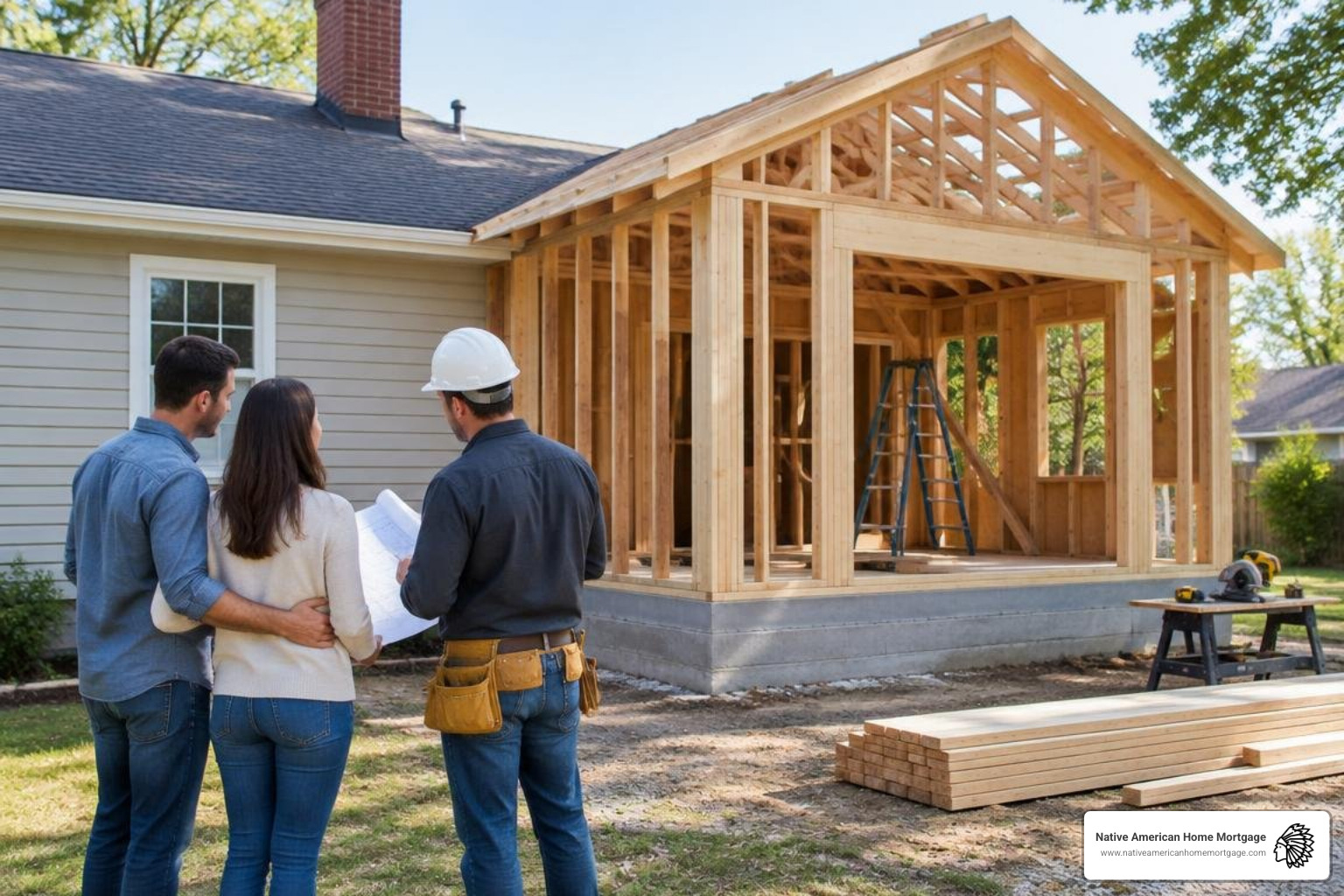
Eligibility Criteria for a 203k Loan for Home Addition
To qualify for an expansion project using a 203(k) loan, you must meet key financial and property standards:
- Credit Score: The minimum credit score to qualify for a 203(k) loan is 620.
- Down Payment: A 3.5% down payment is all that is required for purchases based on the combined purchase price plus renovation costs.
- Property Types: Eligible properties include single-family detached homes, 2–4 unit residential properties (where you live in one unit), approved condominiums (for interior additions/modifications), and townhomes.
- Occupancy: The home must serve as your primary residence; investor flips and second homes are not eligible.
- Loan Limits: Your total loan amount cannot exceed your county’s FHA mortgage limit.
For a detailed walkthrough on setting up your initial file, review these guidelines for qualifying for an FHA 203k loan.
Contractor Standards, HUD Consultants, and Contingency Reserves
Because structural additions carry operational risk, the FHA enforces clear guidelines to protect both you and the property:
- Mandatory HUD 203(k) Consultant: Standard 203(k) projects require an independent, HUD-approved consultant who visits the property, writes the detailed scope of work (the Work Write-Up), prepares cost estimates, and inspects construction stages before approving payments.
- Licensed General Contractors: You must hire a licensed, bonded, and insured general contractor. Self-contracting or DIY labor is prohibited.
- Contingency Reserve: A contingency reserve of 10% to 20% of the cost of labor, materials, and soft costs is factored into the loan. A 10% contingency reserve of the cost of labor, materials and soft costs is optional unless the property is a 2-4 unit property, where it is mandatory to safeguard against unforeseen structural discoveries during framing and foundation work.
Understanding FHA 203(k) Renovation Financing
The core financial advantage of the 203(k) program is its appraisal structure. Instead of evaluating the home in its current state, an appraiser evaluates the architectural plans and contractor bids to determine the After-Repaired Value (ARV). Under FHA guidelines, the maximum allowable loan amount can reach up to 110% of the After-Repaired Value from the appraisal, giving you substantial borrowing power even before groundbreaking begins.
Comparing Standard and Limited FHA 203(k) Programs
| Feature | Standard 203(k) | Limited 203(k) |
|---|---|---|
| Primary Use Case | Major structural expansions & additions | Cosmetic & non-structural repairs |
| Minimum Rehab Amount | $5,000 | No minimum |
| Maximum Rehab Amount | Up to county FHA loan limit | Capped at $35,000 (or $75,000 depending on tier) |
| Structural Changes Permitted | Yes (Additions, load-bearing walls) | No |
| HUD Consultant Required | Yes (Mandatory) | No (Optional) |
| Minimum Down Payment | 3.5% | 3.5% |
| Minimum Credit Score | 620 | 620 |
| Contingency Reserve | 10% to 20% | Optional (0% to 10%) |
FHA 203(k) loans generally provide more flexible credit underwriting and lower initial equity thresholds than many conventional renovation alternatives.
Weighing the Pros and Cons of Single-Mortgage Renovation
Using a single government-backed loan for a major expansion offers notable advantages alongside a few trade-offs:
- Pros:
- Low Initial Equity: Secure construction capital with just 3.5% down.
- Predictable Long-Term Rates: Lock in long-term fixed interest rates rather than high-rate, variable short-term construction notes.
- Immediate Equity Potential: Because loan amounts are calculated on post-renovation equity, your home’s actual finished value often exceeds the total acquisition and construction costs.
- Assumability: FHA loans are assumable by future qualified buyers, preserving value if rates rise.
- Cons:
- Mortgage Insurance: FHA loans require both Upfront Mortgage Insurance Premiums (UFMIP) and annual monthly MIP.
- Documentation Rigor: Detailed architectural plans, permits, and consultant reviews mean longer processing times than standard mortgages.
- Structured Draw Inspections: Contractors must be comfortable receiving payments through escrow draws rather than upfront deposits.
How to Execute Your Project from Application to Completion
Executing a smooth home addition requires aligning your architectural vision with loan milestones from the start.
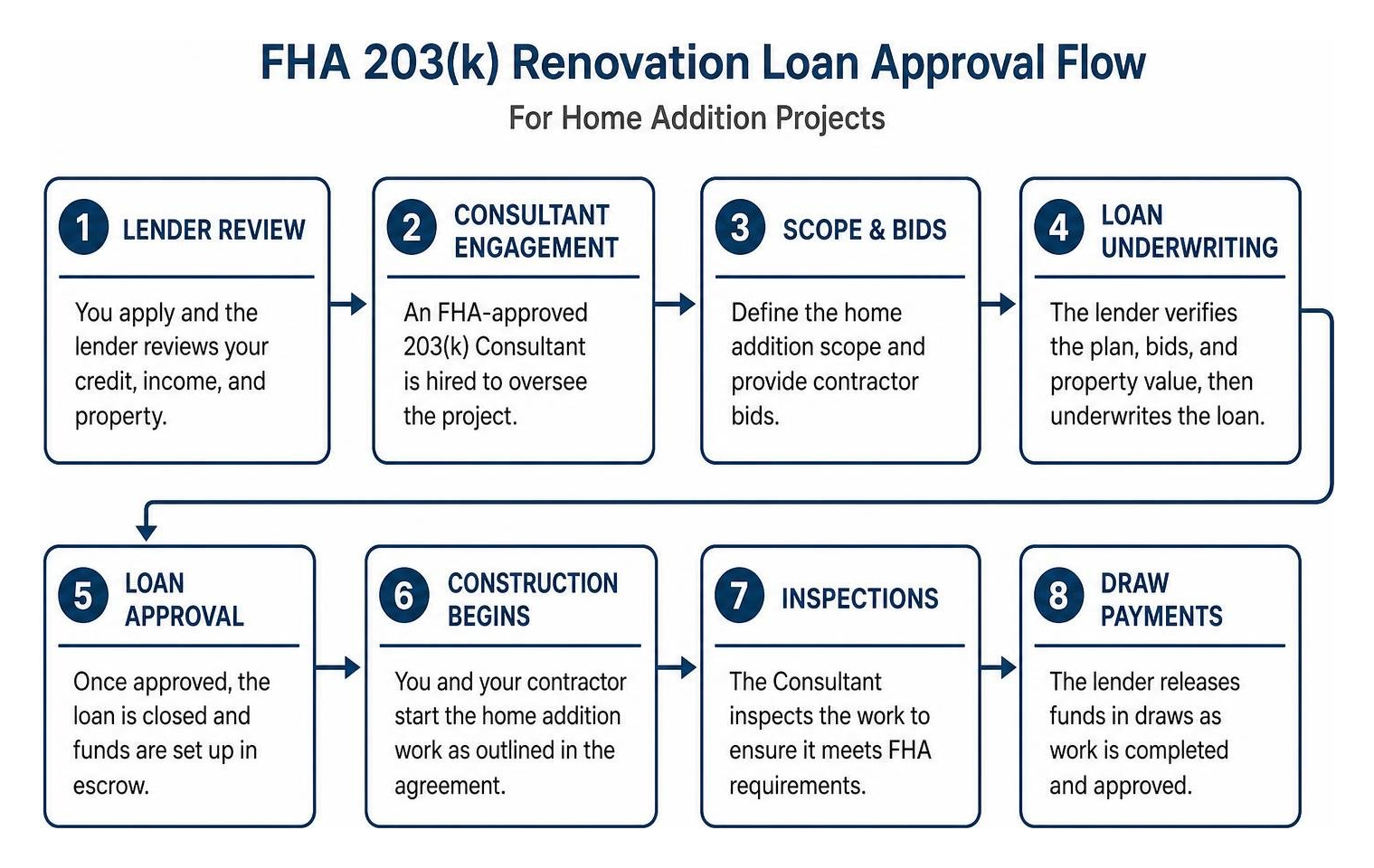
Step-by-Step Workflow for a 203k Loan for Home Addition
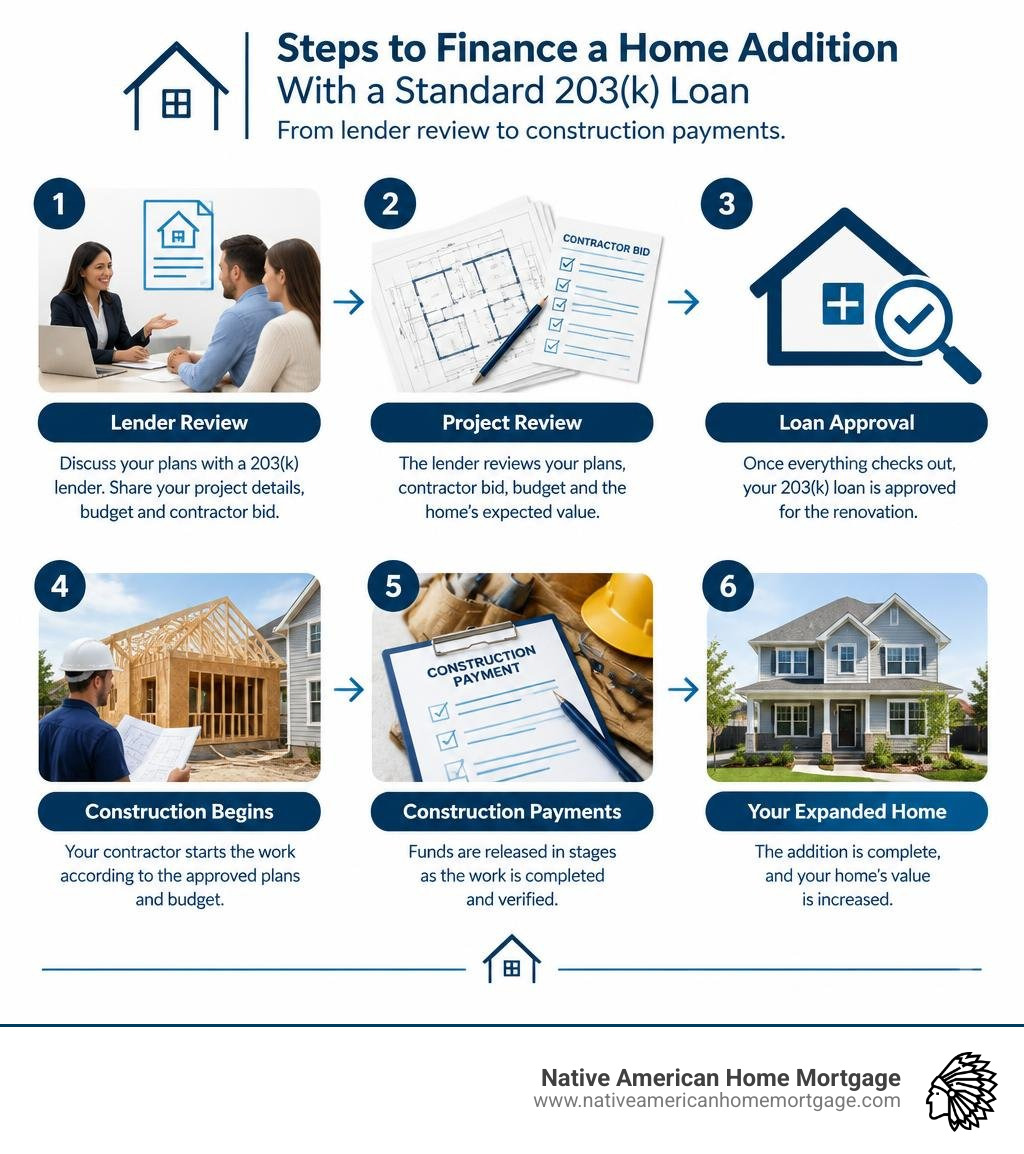
- Lender Pre-Approval: Connect with an FHA-approved lender to evaluate your credit, debt ratios, and maximum borrowing capacity. Following proven FHA 203k pre-approval milestones will keep your application organized.
- Consultant Site Visit: Your HUD Consultant conducts a comprehensive feasibility inspection and prepares the official Work Write-Up and architectural specifications.
- Contractor Selection and Bidding: Your licensed general contractor submits an itemized bid that matches the consultant’s scope of work.
- As-Completed Appraisal: An FHA appraiser reviews the blueprints and bids to determine the projected After-Repaired Value.
- Underwriting and Closing: Once underwriting clears the title, financials, and contractor documents, the loan closes. Purchase or existing mortgage funds are paid out, and all renovation funds are placed into an interest-bearing escrow account.
Six-Month Construction Timeline and Escrow Draw Schedules
Once your loan closes, construction begins under specific guidelines:
- 30-Day Project Commencement: Work must officially start within 30 calendar days of loan closing.
- 6-Month Completion Deadline: Renovations must be completed no more than 6 months after closing.
- Escrow Holdback and Draw Inspections: Construction funds are disbursed in phases. As your contractor completes specific milestones (such as foundation pouring, framing, rough plumbing, or dry-in), the HUD Consultant inspects the work and signs off on an escrow draw release.
- Final Closeout: Upon completion, local building authorities issue a final Certificate of Occupancy, lien waivers are finalized, and any remaining contingency funds are applied directly toward paying down your principal loan balance.
For more technical guidance on navigating complex construction approvals, check out our guide on demystifying construction loan approvals.
Frequently Asked Questions About 203(k) Renovation Loans
Can I refinance my existing mortgage into a 203(k) loan to build an addition?
Yes. If you already own your home, you can execute a rate-and-term refinance with a Standard 203(k) loan. Your new mortgage pays off your existing mortgage balance and rolls the entire cost of the new addition into one monthly payment based on the home’s projected future appraised value.
What is the maximum loan amount and how is the After-Repaired Value calculated?
Your maximum borrowing capacity is determined by taking the lesser of:
- The purchase price (or existing debt on a refinance) plus total renovation costs and soft fees, or
- 110% of the After-Repaired Value (ARV) established by the appraiser.
In all cases, the final loan amount must remain within the published FHA loan limits for your specific county.
Can I complete the home addition work myself using DIY labor?
No. FHA guidelines require all structural expansion work to be performed by licensed, insured, and experienced general contractors. Self-contracting or DIY labor is prohibited to protect structural integrity and safety standards.
Conclusion
Expanding your living space with a home addition doesn’t have to require draining your savings or managing fragmented financing. The FHA Standard 203(k) loan offers a structured path to fund room additions, second-story expansions, and essential structural upgrades with as little as 3.5% down.
To get started on your expansion plans, connect with our team at Native American Home Mortgage to explore your options and structure the right financing for your build.