What Credit Score Do You Need for a 203(k) Loan?
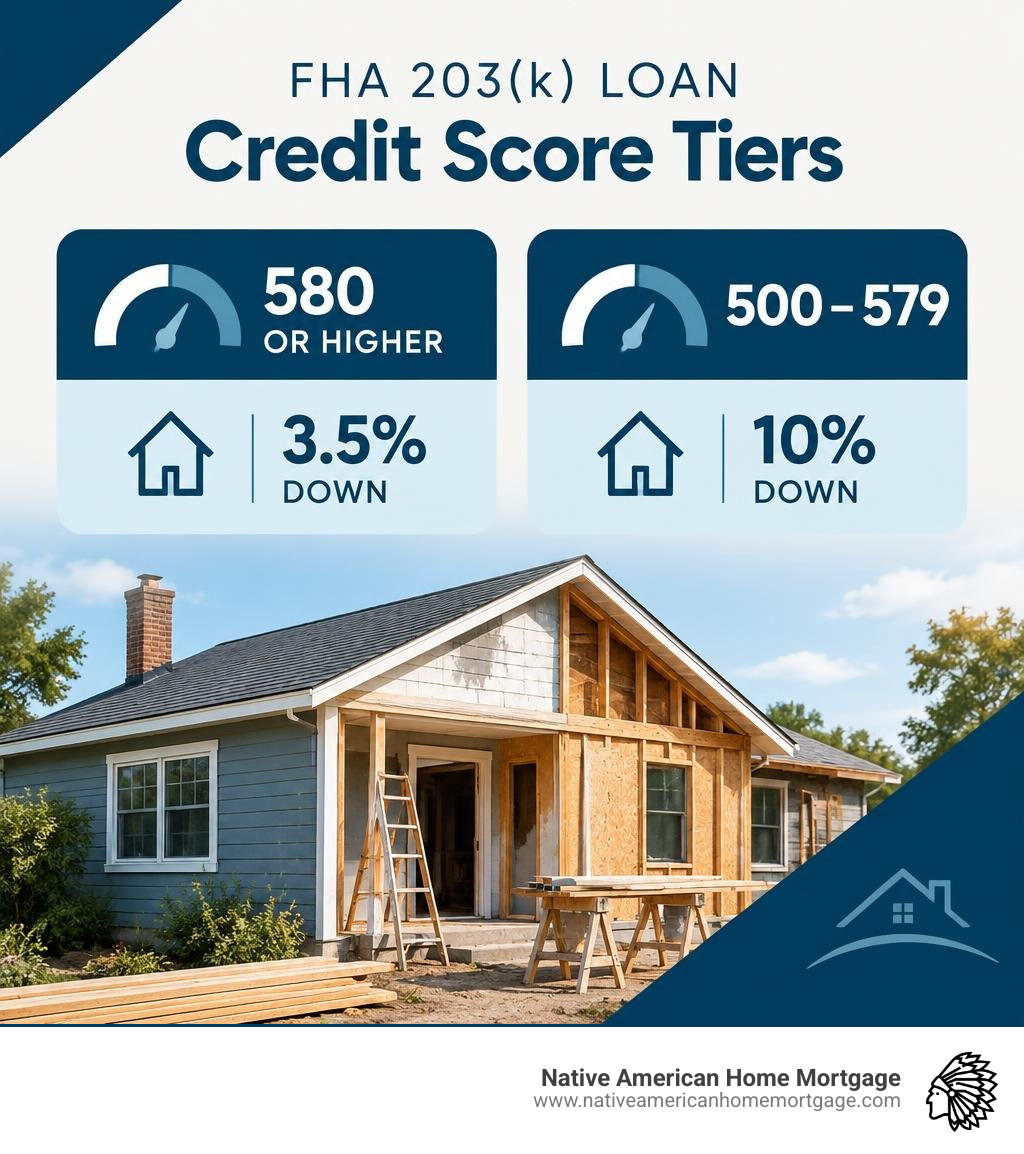
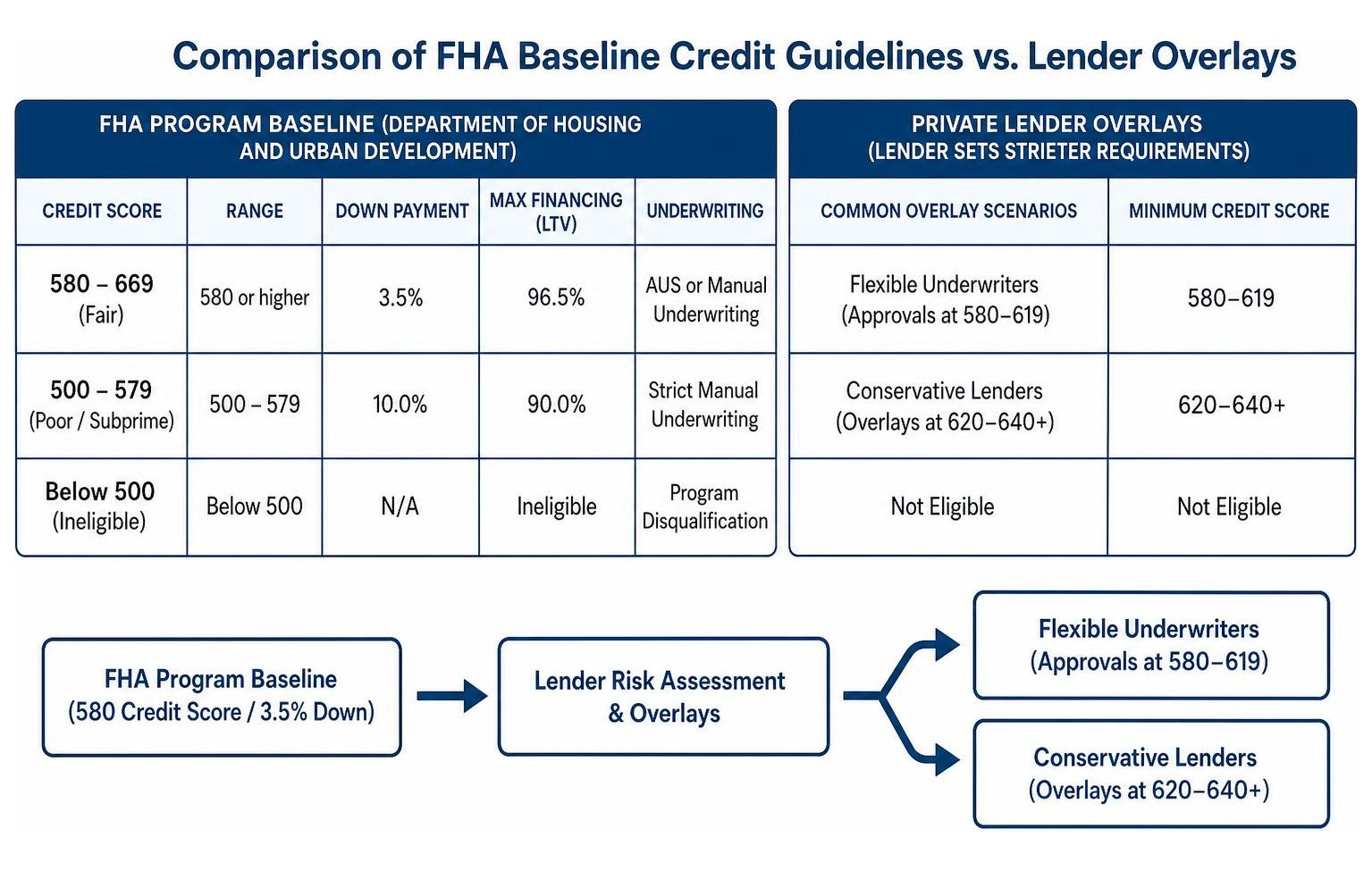
A 203k loan credit score of 580 or higher may qualify you for a 3.5% down payment. A score from 500 to 579 may still qualify, but you would need at least 10% down. Scores below 500 are not eligible for FHA-insured financing.
These FHA thresholds apply to both Standard and Limited 203(k) loans. A lender may set a higher minimum score, and your score can also affect the interest rate you’re offered. That makes it worth checking your credit before you plan your renovation budget.
I’m Dale Gremillion, a senior loan officer and branch manager with over 25 years of residential mortgage experience, including FHA lending. I’ll help you understand how your 203k loan credit score fits into the larger loan decision.
Understanding 203k Loan Credit Score Requirements and Down Payment Tiers
Finding a diamond in the rough can feel exciting, but turning that neglected property into your forever home requires a solid financing strategy. The Federal Housing Administration (FHA) established the HUD 203(k) Rehabilitation Mortgage Insurance Program to give homebuyers and homeowners the power to finance both the purchase (or refinance) and the cost of rehabilitation through a single mortgage.
When evaluating your application, underwriting starts with your credit profile. Your credit score directly dictates the loan-to-value (LTV) ratio you can access, which in turn determines your minimum required down payment.
| Credit Score Tier | Credit Rating | Minimum Down Payment | Maximum Loan-to-Value (LTV) | Underwriting Pathway |
|---|---|---|---|---|
| 740+ | Excellent | 3.5% | 96.5% | Automated Underwriting (AUS) |
| 700 – 739 | Very Good | 3.5% | 96.5% | Automated Underwriting (AUS) |
| 670 – 699 | Good | 3.5% | 96.5% | Automated Underwriting (AUS) |
| 580 – 669 | Fair | 3.5% | 96.5% | AUS or Manual Underwriting |
| 500 – 579 | Poor / Subprime | 10.0% | 90.0% | Strict Manual Underwriting |
| Below 500 | Ineligible | N/A | Ineligible | Program Disqualification |
Understanding these thresholds allows you to map out your homebuying timeline and build your savings before making an offer on a fixer-upper.
FHA Guidelines: 580 vs. 500-579 Credit Score Thresholds
Under baseline FHA guidelines, a credit score of 580 represents the dividing line between standard low-down-payment financing and restricted borrowing. If your score sits at 580 or higher, you can access maximum financing of 96.5 percent. This means your down payment is just 3.5 percent of the total project cost—calculated by combining the property purchase price and the total renovation budget.
For borrowers with scores between 500 and 579, the FHA caps maximum financing at 90 percent LTV. Securing this requires a 10 percent equity contribution or down payment. In addition, applications in this tier cannot pass through standard Automated Underwriting Systems (AUS) and require rigorous manual underwriting. Reviewing our beginners guide to qualifying for an FHA 203k loan is a great first step if you need to understand how these early qualification checks operate in practice.
Understanding Lender Overlays and Minimum Scores
While the Department of Housing and Urban Development sets the official baseline at 580 (or 500 with 10 percent down), mortgage lenders have the legal authority to set stricter internal guidelines called lender overlays.
Because renovation mortgages carry construction risk alongside standard mortgage default risk, many lenders implement overlays that establish a hard minimum score of 620 or 640 for 203(k) transactions. These overlays protect lenders from non-completion risks, cost overruns, and borrower payment shocks during the rehab phase.
When shopping for a renovation mortgage, work with lending specialists who underwrite directly to FHA guidelines rather than adding excessive restrictions that shut out qualified buyers.
How Credit Scores Impact 203k Interest Rates and Loan Costs
Your credit score influences much more than a simple yes-or-no approval decision; it directly shapes the total cost of your loan. Interest rates on renovation loans are slightly higher than standard purchase mortgages—typically by 0.75% to 1.00%—because of the administrative complexity of managing construction escrow accounts, contractor draw schedules, and consultant inspections.

Borrowers with credit scores above 740 capture the most favorable interest rates and lowest loan pricing adjustments. As credit scores step down through the 600s into the high 500s, lenders price in additional credit risk through higher interest rates and origination points. Over a 30-year amortization schedule, a 0.50% interest rate difference on a $350,000 combined loan balance adds tens of thousands of dollars in cumulative interest charges.
Minimum 203k Loan Credit Score for Standard vs. Limited Loans
The FHA 203(k) initiative is divided into two distinct sub-programs, each tailored to different scopes of work:
- Limited 203(k) (formerly Streamline): Designed for minor remodeling and non-structural repairs. It caps total renovation costs at $35,000 (or up to $75,000 depending on specific local program limits) and excludes structural alterations.
- Standard 203(k): Required for major structural work, additions, load-bearing wall alterations, complete rehabilitations, or projects with total repair costs starting at a mandatory minimum of $5,000 with no maximum limit beyond county loan caps. Standard loans mandate the involvement of a certified HUD 203(k) Consultant.
While HUD enforces the identical 580 minimum baseline across both loan types, lender overlays diverge significantly between them. Lenders frequently approve Limited 203(k) loans at a 580 or 600 score because the construction risk is minimal. Conversely, Standard 203(k) loans often encounter lender overlays requiring a 620 to 640 credit score to offset the hazards of major construction. To explore the full framework of both programs, see the complete guide to 203k rehab loan requirements.
Mortgage Insurance and Credit Score Tiers in 2026
Every FHA loan includes Mortgage Insurance Premiums (MIP), regardless of whether your credit score is 580 or 800. These premiums protect the government insurance fund that makes low-down-payment lending possible.
- Upfront MIP (UFMIP): Equal to 1.75% of the total base loan amount. This fee is typically financed directly into the mortgage balance at closing.
- Annual MIP: Paid in twelve monthly installments as part of your regular mortgage payment. For borrowers utilizing the 3.5% down payment option, annual MIP generally ranges between 0.50% and 0.55% of the outstanding balance.
Unlike conventional Private Mortgage Insurance (PMI)—which can be canceled once your home reaches 20% equity—FHA annual MIP remains on the loan for the entire mortgage term when you put down less than 10%. Maintaining a strong credit score makes it easier to refinance into a conventional loan down the road once your completed renovations build sufficient market equity.
Beyond Credit Scores: Essential Approval Factors for FHA 203k Loans
A solid credit score gets you through the front door, but an underwriter assesses your entire financial profile before issuing a clear-to-close.

Renovation lending requires coordination between the borrower, the lender, the appraiser, and licensed contractors.
Debt-to-Income Limits and Income Verification
Your Debt-to-Income (DTI) ratio measures your monthly debt obligations against your gross monthly income:
- Front-End Ratio (Housing Costs): The proposed principal, interest, taxes, homeowner insurance, and MIP should ideally stay below 31% to 35% of your gross monthly income.
- Back-End Ratio (Total Debt): Your housing costs plus all recurring consumer debts (student loans, auto financing, minimum credit card payments) should not exceed 43%. Some automated underwriting approvals allow ratios up to 45% or 50% when supported by strong compensating factors such as cash reserves.
Underwriters verify your income through two years of W-2s, recent pay stubs, and federal tax returns for self-employed applicants. You can read more about documentation steps in our guide on FHA 203k pre-approval requirements and timeline.
Property Eligibility and Renovation Planning
FHA 203(k) financing cannot be used for investment property flips. Eligible properties must serve as the borrower’s owner-occupied primary residence for at least 12 months following completion and can include:
- Single-family detached homes
- 2- to 4-unit residential properties (where you occupy one unit)
- Approved condominiums (interior alterations only)
- Manufactured homes meeting HUD standards
All work must be completed by licensed, insured, and experienced general contractors. Funds are placed into an interest-bearing escrow account and disbursed in stages following satisfactory site inspections. DIY labor is strictly restricted to prevent unfinished projects and protect structural safety.
Actionable Steps to Improve Your 203k Loan Credit Score
If your credit score currently hovers near the minimum thresholds, dedicating two to four months toward credit optimization can yield lower interest rates and smoother loan underwriting.
- Reduce Revolving Credit Balances: Your credit utilization ratio (credit card balances divided by credit limits) accounts for roughly 30% of your credit score. Bringing your utilization below 10% on every individual revolving account will boost your score quickly.
- Audit Your Credit Reports for Errors: Obtain free annual reports from Equifax, Experian, and TransUnion. Dispute incorrect late marks, duplicate collections, or outdated judgments.
- Eliminate New Credit Inquiries: Avoid opening new credit cards, auto loans, or retail financing plans within six months of applying for a mortgage.
- Establish On-Time Payment Streaks: Payment history makes up 35% of your score. Set up automatic minimum payments across all active trade lines.
- Address Recent Collection Accounts: Settle outstanding collections or arrange pay-for-delete agreements where possible, as recent unpaid balances trigger manual underwriting conditions.
How to Boost Your 203k Loan Credit Score Before Applying
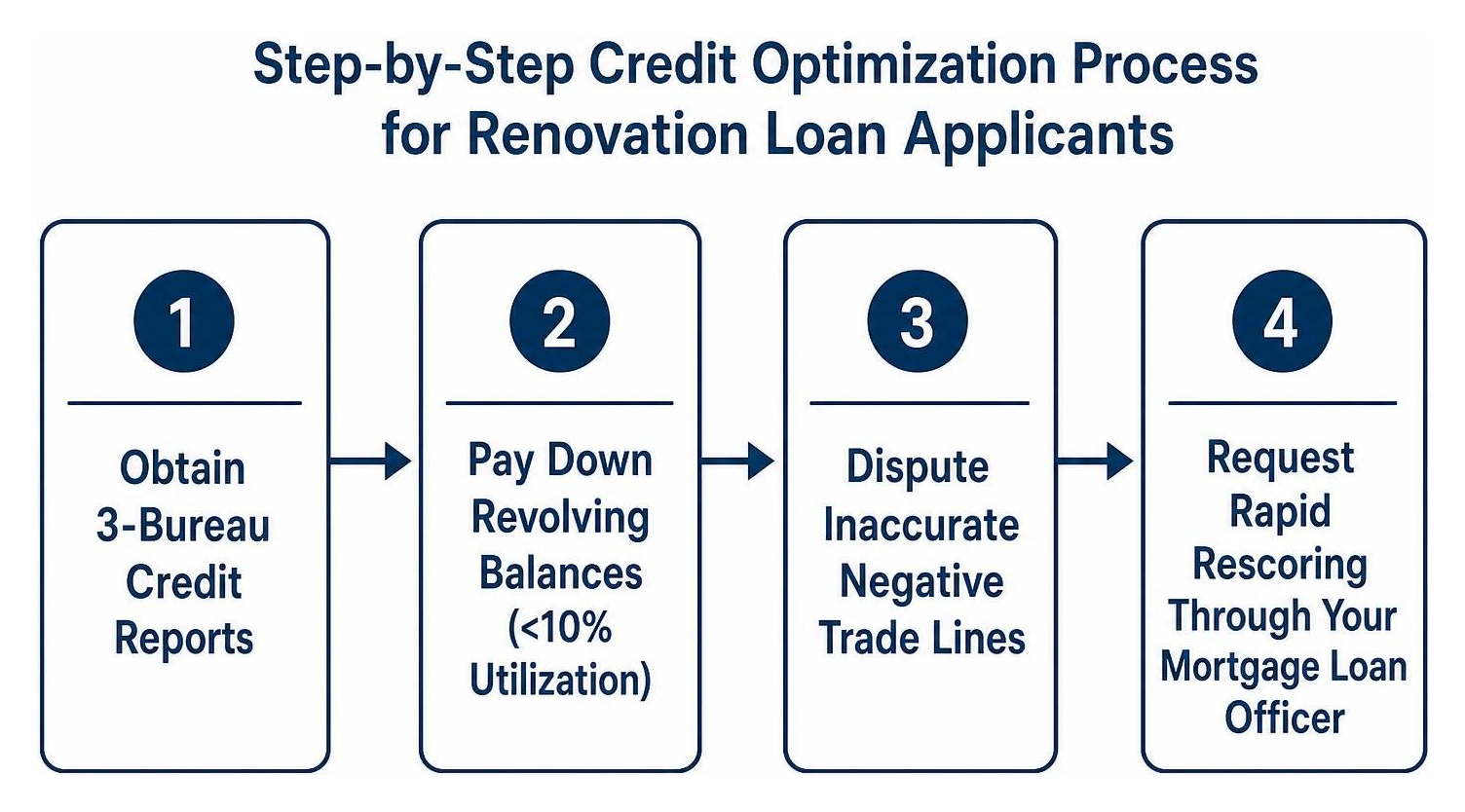
When working with our loan officers, ask about rapid rescoring. If you pay down significant credit card debt right before applying, rapid rescoring allows us to submit proof of payment directly to credit repositories, updating your official mortgage credit scores in days rather than waiting for standard monthly reporting cycles.
Alternative Financing and Government Loan Programs
If you are exploring renovation financing, it helps to understand how other government-backed mortgages compare. For Native American, Alaska Native, and Hawaiian Home Lands borrowers, the HUD Section 184 Indian Housing Loan Guarantee Program provides a specialized financing vehicle with low down payments, flexible underwriting, and no monthly credit-based mortgage insurance premiums.
While the 203(k) remains the leading single-family rehabilitation loan across standard municipal markets, you can read our guide to exploring alternative home financing options to compare products designed for specific regional and tribal needs.
Frequently Asked Questions About 203k Loan Credit Scores
Can I get a 203k loan with a credit score under 580?
Yes. Official FHA guidelines allow approvals for credit scores between 500 and 579, provided you make a minimum down payment of 10%. However, because these applications require manual underwriting and pose higher default risks, you will need to find a lender that does not enforce an overlay above 580, and you must demonstrate compensating factors such as steady employment, low debt ratios, and cash reserves.
Does a higher credit score lower my 203k loan interest rate?
Yes. Mortgage pricing matrices adjust rates based on credit brackets. A borrower with a 740 credit score typically receives a lower interest rate, fewer origination points, and lower closing costs than an applicant with a 600 score applying for the exact same loan amount.
What is the difference in credit requirements between Limited and Standard 203k loans?
The FHA guidelines establish the same 580 baseline (with 3.5% down) for both programs. However, because Standard 203(k) loans involve major structural reconstruction, many lenders apply higher internal credit overlays (often 620 to 640) for Standard projects compared to Limited loans.
Conclusion
Securing an FHA 203(k) loan is one of the most practical ways to turn an affordable fixer-upper into a customized home. While you only need a 580 credit score to access the 3.5% down payment tier under official FHA rules, taking proactive steps to lift your score into the 640+ or 700+ range can lower your borrowing costs, expand your lender options, and smooth out underwriting approval.
At Native American Home Mortgage, we specialize in helping individuals and families find practical financing solutions tailored to their personal goals. When you are ready to explore your options, start by navigating the 203k FHA loan rehab journey with our experienced lending team today.